Click any lines to type. Answers stay in this browser until you clear them.
Everwise
Classroom Companion
Every Trail, taught together with one screen and pen and paper.
grow.evergreened.org
How to use this guide
Everwise is built for students working on their own laptops. This guide is for teachers who would rather run it as a whole class. You play the videos on one screen, and students write their answers on paper.
What you need
An Everwise teacher account. Sign in at grow.evergreened.org/teacher/login.
A projector or large screen, with speakers.
Paper for each student: the printed student pages from this guide, or a composition book.
Showing the videos
Sign in and click Course in the menu.
Open the Trail you are teaching. Teachers can open any Trail, in any order.
Go through the activities in order and play each video full screen.
The steps in each Trail's plan match the activities in Course, in the same order, so you can follow along on screen. All the videos together run about 3.9 hours.
How each Trail is laid out
Each Trail starts on a new page with a plan for you. The plan lists every step, what to do, and how long the videos and timed activities take. The student pages come next, and the Trail's Waypoint has a page of its own at the end.
Every Trail opens with a Discussion Circle, a recorded conversation about one statement. Students write a first reflection, then watch shorter videos, answer questions, and work through a case study. Some Trails have a game or interactive, which works best played together on the projector. The Waypoint is a short piece of writing that becomes one part of each student's Personal AI Constitution.
Printing
Print the whole guide, or one Trail at a time by choosing a page range in the print window.
Students need the pages that follow each Trail's plan. Keep the plan pages and the answer keys at the back for yourself.
For a PDF, choose Save as PDF as the printer. Turn on Background graphics if your browser shows that option, so the colors and lines print.
Using composition books instead
Every prompt and question in a Trail has a number. Students write the Trail and the number in their book, for example "Trail 2, #4," then their answer. For multiple-choice questions, the letter is enough.
Filling it in on a computer
Students can type into this guide in a web browser. Click any set of lines to type, or click a circle to choose an answer. Answers are saved in that browser only, so students should choose Print or save as PDF when they finish. On a shared computer, click Clear my answers before the next student starts.
Badges and the constitution
Work done on paper doesn't show up in Everwise, so it can't earn badges by itself. If your students have Everwise accounts, they can type their Waypoints in later to earn each Trail's badge and work toward the microcredential. The Conclusion pages let every student copy their Waypoints into a finished, signed paper constitution either way.
The rubric Everwise uses to review Waypoints is at the back of this guide, after the answer keys.
Meet Sloane and Axel, learn how Everwise works, and get the three words that explain almost every use of AI.
Videos: 22 min. Videos and timed activities together: 47 min. Games, review, and the Waypoint take as long as you give them.
#
Step
What to do
Time
1
Video: Discussion Circle
Read the topic aloud: “There is nothing only a human can do.” Then play the video.
6 min
2
Reflection
Students write their answers.
5 min
3
Video: The AI Cheat Code
Play the video.
1 min
4
Video: Shortcuts
Play the video.
5 min
5
Reflection
Students write their answers.
5 min
6
Video: Supports
Play the video.
6 min
7
Reflection
Students write their answers.
5 min
8
Video: Superpowers
Play the video.
3 min
9
Reflection
Students write their answers.
5 min
10
Video: 3S Recap
Play the video.
1 min
11
Final Thought
Students write their answers.
5 min
12
Summary
Review the main points together.
Trail 0: Welcome to Everwise
Video: Discussion Circle
Watch together6:25
Agree
Of course, humans can do things better… But the AI can do these things. …it's not going to do them as well, but it can definitely do them.
— Liam
Disagree
AI will never break its feet to fit into pointe shoes, and AI will never go on stage and perform and have a standing ovation. AI will never be at a wedding… It will never be at a funeral… People want to see humans succeed. They want to see humans do hard things. It's not hard for a car to go fast. It's hard for a human to go fast.
— Raegan
Reflection
1This Circle discussion explored the topic of human specialness. Given all that AI can do now, is there anything that only humans can do? Put another way, are humans “special” anymore? What do you think?
Video: The AI Cheat Code
Want to understand AI fast? It comes down to three words. This video gives you the AI cheat code, and it works in school, in college, and at work.
The trick? Use the cheat code in the wrong way and the only thing you cheat is yourself.
Watch together0:42
Video: Shortcuts
AI can finish huge jobs in seconds. So why are your teachers so worried about it? This video explains the trade.
Watch together4:35
Reflection
2Think of a skill you're glad you learned the hard way, like a sport move, a song, or a recipe. What would you have missed if something had done it for you?
Video: Supports
A microwave problem? A friend with a new health problem? No idea what job you want? AI can help with almost anything. That's what makes it so helpful–and why humans can learn to love AI too much.
Watch together5:41
Reflection
3Name one person you could go to with something big, like a friend, family member, coach, or teacher. What makes it easy or hard to go to them? If no one comes to mind right now, what would make it easier to ask someone?
Video: Superpowers
Any teen with a phone can now build an app, make an album, or start a business. So what could go wrong? This video covers the biggest AI power and its sneakiest Shadow.
Watch together3:12
Reflection
4If you could build or learn one thing that's beyond your current skills today, what would it be? Who's one real person you'd want to show it to?
Video: 3S Recap
Watch together0:59
Final Thought
5Think of one way you, or someone you know, has used AI or might use it. Is it a Shortcut, a Support, or a Superpower? How can you tell? Which Shadow should they watch for?
Summary
Key Ideas
Shortcut = AI does it for me. Rule: do more or better work, not less.
Support = AI does it with me. Rule: don't trust AI more than the people who love you.
Superpower = AI does what's beyond me. Rule: touch grass.
Shortcuts are fine, but they're the weakest of the three. AI is at its best when it helps you grow and do what you couldn't do alone.
1
Are We Living in the Most Important Time in History?
From Alan Turing's codebreaking machines to ChatGPT, trace how AI got here and decide for yourself whether this moment is as big as people say.
Learning objective
I can describe the moment we're living in and back it up with evidence.
Videos: 22 min. Videos and timed activities together: 61 min. Games, review, and the Waypoint take as long as you give them.
#
Step
What to do
Time
1
Video: Discussion Circle
Read the topic aloud: “AI is the most important invention of all time.” Then play the video.
8 min
2
Reflection
Students write their answers.
5 min
3
Video: The Origin of AI
Play the video.
2 min
4
Video: Two Camps
Play the video.
2 min
5
Check for Understanding
Students answer on paper. The answers are in the key at the back.
2 min
6
Video: How Machines Learn
Play the video.
3 min
7
Check for Understanding
Students answer on paper. The answers are in the key at the back.
2 min
8
Video: The Big 3 of Modern AI
Play the video.
3 min
9
Case Study: The Cost of Intelligence
Show the article on the projector, or print it. Students write their answers.
30 min
10
Video: The Rise of Algorithms
Play the video.
2 min
11
Video: The Soap Opera
Play the video.
2 min
12
Summary
Review the main points together.
13
Glossary
Key terms for the Trail. They are printed in the student pages.
14
Interactive Timeline
Play it together on the projector.
15
Waypoint: The Preamble
Students write their Waypoint. It has its own page at the end of the Trail.
Trail 1: Are We Living in the Most Important Time in History?
Video: Discussion Circle
Watch together7:46
Agree
When we look back 100 years from now, whether it is the greatest thing of human history or the worst thing of human history, I do believe that now we stand at the crossroads…and we will look back and say that the invention of AI is what changed the course of human history.
— Desmond
Disagree
If you took agriculture away from any society in the modern day, it would be destroying that culture… If you took away LLMs from the current society, I don't think that it would cripple or destroy or really harm that culture in any noticeable way aside from potentially economically, and that's why I think it's not the greatest invention of all time.
— Clark
Reflection
1Humans have figure out some pretty epic things: Agriculture, the alphabet, money, metalworking, the printing press, electricity, flight, space travel, the internet. Does AI beat them all? What do you think? What’s the greatest invention of all time? Explain your answer.
Video: The Origin of AI
Consider: Can a machine think? How would you know?
Watch together1:55
Video: Two Camps
In 1956, a group of scientists gave a new field its name: artificial intelligence. Then they split into two camps with very different ideas about how to build it.
Watch together2:08
Check for Understanding
Quick check on where AI came from.
2What helped Alan Turing's team use a machine to crack the day's Enigma settings?
3In Turing's thought experiment, a machine might be said to have human-like intelligence if a person chatting with it and a human can't tell which one is the machine.
4After the Dartmouth workshop, AI split into two camps. Which approach became machine learning, the one that is everywhere today?
Video: How Machines Learn
How does a machine “learn” if nobody tells it the rules? Think of a toddler sorting pictures of cats and dogs.
Watch together3:08
Check for Understanding
Let's make sure the core idea of machine learning landed.
5When a machine learning system scores 'happy' and 'cheerful' as related, it means the machine understands what those words mean.
6Why didn't machine learning take off back in the 1980s?
7Which is an example of narrow intelligence from the video?
Video: The Big 3 of Modern AI
Why did AI suddenly take off after decades of slow progress? Three ingredients finally showed up at the same time.
Watch together2:36
Case Study: The Cost of Intelligence
Whether AI is the most important ever or not, it is starting to become the most expensive.
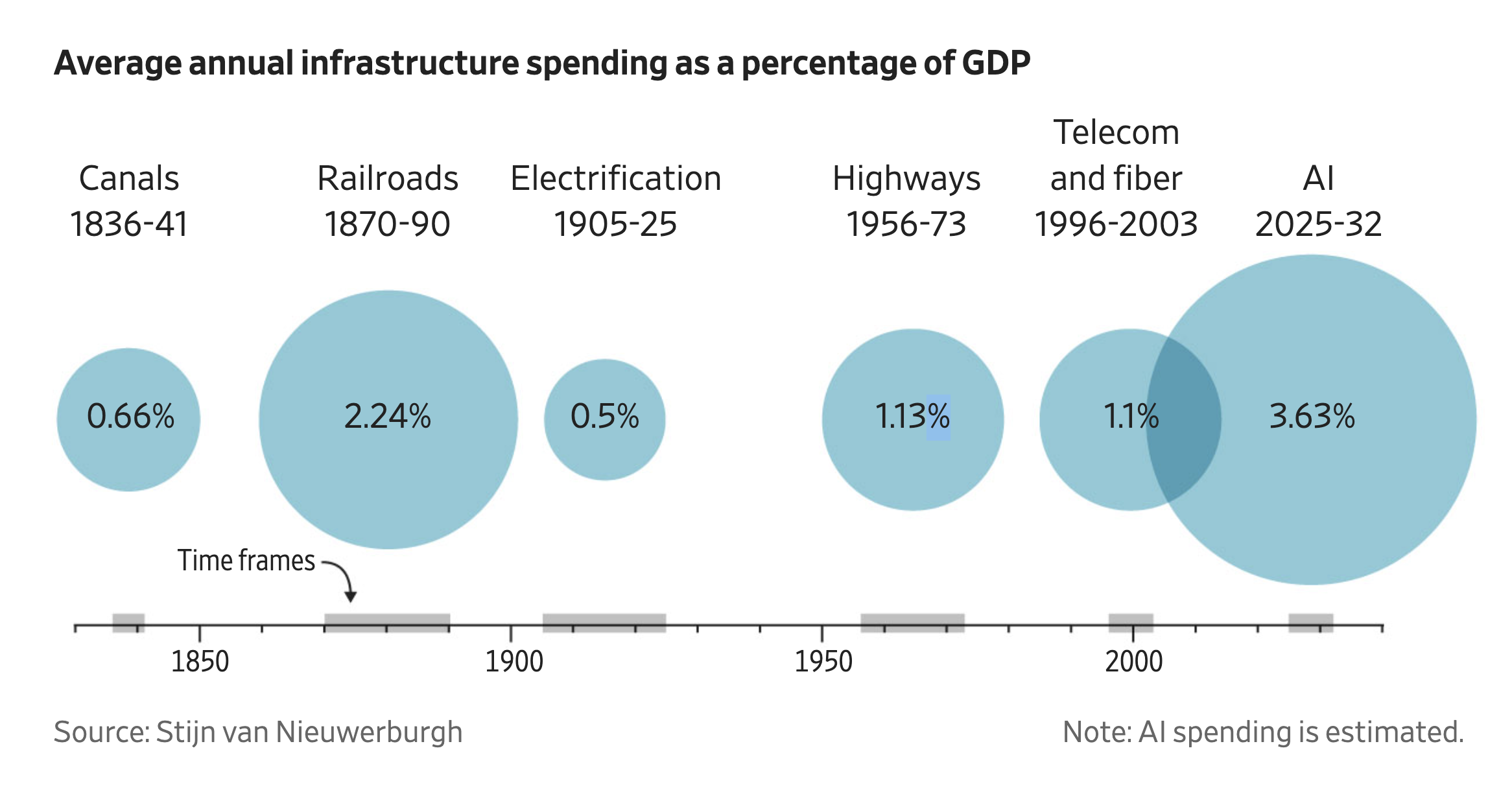
The Wall Street Journal published an article titled The AI Build-Out Is Becoming the Biggest Economic Bet in U.S. History.
Click the link to read the article, then answer the following questions:
9What is one way AI investment is impacting the economy?
10Look at the chart above. All of these American investments are still in use and make America as productive and prosperous as it is. Do you think AI will fit that pattern–or break the pattern?
Video: The Rise of Algorithms
Your feed seems to know you pretty well. This video shows how the tech behind your feed led to the chatbots we use today.
Watch together2:04
Video: The Soap Opera
Believe it or not: behind the somewhat nerdy science of AI, there is a lot of drama: rival companies, big money, and a race nobody wants to lose.
Watch together2:29
Summary
The Origin of AI
In World War II, a machine helped crack Germany's secret Enigma code by finding patterns in its messages.
Machines are good at spotting patterns because people are predictable. We repeat ourselves.
After the war, Alan Turing asked a big question: if a machine can recognize patterns, could it someday think?
His test: if you chat with a person and a machine and can't tell which is which, maybe the machine has human-like intelligence.
Two Camps of AI
Camp one: write rules that tell the machine exactly what to do. ELIZA, a chatbot from the 1960s, worked this way.
People got attached to ELIZA, even when they knew it was a simple trick.
Camp two: show the machine lots of examples and let it find the patterns itself.
Camp two won. That approach is called machine learning, and it's behind almost all the AI you use today.
How Machines Learn
Machines learn by seeing huge numbers of examples and noticing what tends to go together.
The machine doesn't understand words. It keeps track of which ones show up together.
All of this takes a lot of math, which takes a lot of computing power. For years, computers weren't strong enough.
So for a long time, AI stayed “narrow”: good at one small job, like reading ZIP codes on mail.
The Big 3 of Modern AI
Better methods: deep learning let machines find patterns no human could spot.
Lots of data: huge collections of labeled examples, like millions of tagged photos.
Computing power: chips built for video games turned out to be perfect for training AI.
Once all three came together, AI started beating people at hard games and helping scientists predict the shapes of proteins.
The Rise of Algorithms
Feed algorithms learned what keeps people watching. Posts that stir up strong feelings often win.
But these systems could only show you what people had already made. They couldn't create anything new.
In 2017, researchers invented the transformer, a design that's very good with language.
Train a transformer on huge amounts of text and you get a large language model (LLM), the kind of AI behind today's chatbots.
The AI Soap Opera
A handful of companies are racing to build the most powerful AI. Many started as rivals or spin-offs of each other.
ChatGPT launched in late 2022 and became one of the fastest-growing apps ever.
Once the money got big, most companies stopped sharing their best models. You pay to use them.
Some companies push the other way and release models that anyone can use.
Glossary
Pattern
something that repeats in a way you can predict
Turing Test
a test of whether a machine can pass as human in a chat
Artificial intelligence (AI)
computer systems that do tasks we usually think need human thinking
Machine learning
teaching a computer with examples instead of rules
Correlation
when two things tend to show up together
Compute
the computing power needed to train and run AI
Narrow AI
AI trained to do one specific job
Algorithm
a step-by-step recipe a computer follows
Deep learning
a powerful kind of machine learning that finds very complex patterns
Training data
the examples an AI learns from
GPU
a computer chip first made for video games, now used to train AI
Recommendation algorithm
a system that guesses what you'll want to see next
Transformer
an AI design that's very good at understanding and producing language
GPT
short for Generative Pre-trained Transformer
Large language model (LLM)
an AI trained on huge amounts of text to produce language
Generative AI
AI that makes new content, like text, images, or music
Closed model
an AI model a company keeps private; you pay to use it
Open model
an AI model released for anyone to use or build on
I can describe the moment we're living in and back it up with evidence.
You've seen how AI got here, from a summer workshop in 1956 to the chatbot in your pocket. You've learned that today's AI learns from examples instead of following rules, and that big tech booms have happened before. Now you'll start your own AI constitution: your rules for living with AI. You'll build on it as you complete every Trail.
First up: The Preamble (the opening of your personal AI constitution).
You're going to write 1–3 paragraphs responding to the following questions:
We are living in a moment when AI ___. I know this because ___. (Pick one fact from this Trail, or bring your own and say where it came from.)
This is important because ___.
It matters to me because ___.
Suggested 90–120 words.
2
The End of the World As We Know It
Axel makes the case for speeding AI up, Sloane makes the case for slowing it down, and you decide where you stand in a race nobody voted for.
Learning objective
I can explain where I stand on AI while understanding why other people think differently.
Videos: 22 min. Videos and timed activities together: 62 min. Games, review, and the Waypoint take as long as you give them.
#
Step
What to do
Time
1
Video: Discussion Circle
Read the topic aloud: “We should stop building AI.” Then play the video.
8 min
2
Reflection
Students write their answers.
5 min
3
Video: The End of the World As We Know It
Play the video.
1 min
4
Video: The Accelerationist Case
Play the video.
7 min
5
Video: The Doomer Case
Play the video.
4 min
6
Check for Understanding
Students answer on paper. The answers are in the key at the back.
5 min
7
Video: The Race is On
Play the video.
2 min
8
Case Study: Who Should Control AI?
Show the article on the projector, or print it. Students write their answers.
30 min
9
Summary
Review the main points together.
10
Glossary
Key terms for the Trail. They are printed in the student pages.
11
The Third Camp
Play it together on the projector.
12
Waypoint: Pick Your Lane
Students write their Waypoint. It has its own page at the end of the Trail.
Trail 2: The End of the World As We Know It
Video: Discussion Circle
Watch together8:11
Agree
I'm a very artistic person myself. I love it and I think human expression and art is one of the most authentic ways you can do something and express yourself… If this sort of advanced technology just continues and develops over time, there really is no end to it. And how do we know at one point it's going to be taking away from human expression and human quality and our nature?
— Vivienne
Disagree
Well, I think if we stop right now, those problems are going to continue. They're not just going to go away if we stop progressing AI. I think that by progressing AI, we can take away the problems that it has.
— Elaine
Reflection
1This Circle discussion explored whether humans should stop building AI. Some said AI is already hurting how students learn and how artists create, and that it's hard to control. Others said stopping wouldn't fix those problems, and that other countries or companies would keep building anyway. Should we stop, slow down, or keep going? What do you think?
Video: The End of the World As We Know It
The world is changing fast because of AI. Some people are thrilled. Others are scared. Learn why both sides feel the way they do
Watch together1:11
Video: The Accelerationist Case
Accelerationist say: There’s a lot to like about AI, if you give it a fair chance.
Watch together6:36
Video: The Doomer Case
Doomers say: If you’re not worried, you’re not paying attention.
Watch together4:17
Check for Understanding
Let's see how well you understand Axel's and Sloane's arguments about the future of AI.
2When people say building AI too fast is dangerous, Axel uses airplanes as an example. What is his point?
3Axel says AI gives "genius tools to everyone." What is one big change he mentions to prove this?
4Sloane worries about teenagers using AI chatbots for therapy or friendship. How does she say AI is different from older social media apps like TikTok or Instagram?
5What wild experiment does Sloane bring up to show that we can't always predict or trust what AI will do?
6What does Sloane find confusing and scary about the leaders of top AI companies?
Video: The Race is On
Whatever you think about AI, a race is happening. And you're in it, whether you signed up or not.
Watch together1:48
Case Study: Who Should Control AI?
In September 2026, leaders from some of the world's largest AI companies met with President Trump and signed an agreement about AI safety.
The agreement asks companies to monitor their own AI systems, use independent outside auditors, and address safety problems. However, the commitments are voluntary rather than legally enforceable.
Read about the agreement in the linked PBS NewsHour article. You can also read the actual agreement. It's only two pages, including the signatures, and isn't technical.
This isn't the first time AI leaders have publicly warned about AI risks. In 2023, many signed another statement comparing the potential dangers of AI to nuclear war and pandemics.
Read the article and, if you'd like, the original agreement. Then consider both sides of the debate and answer the following questions:
7The Trump Administration wants the United States to lead the world in AI development and favors fewer government restrictions. Why might Team Go argue that developing AI as quickly as possible is the best way to solve major world problems?
8AI leaders have warned about serious risks while continuing to develop increasingly powerful AI systems. If you were in charge, what risks or worst-case scenarios would convince you to slow down or pause AI development, even if it meant falling behind other countries?
9The agreement asks AI companies to monitor their own safety practices and work with independent auditors, without making these commitments legally binding. Do you think this is enough to protect society? Who should be responsible for overseeing AI safety, and why?
Summary
Two Sides of the Same Future
Nobody knows yet whether AI will be humanity's “last invention.” But it's already changing the world we grew up expecting.
Accelerationists believe faster AI progress will make the world better.
Doomers believe moving too fast on AI is dangerous.
Plenty of people land somewhere in between. Over this Trail, you'll figure out where you stand.
The Accelerationist Case
AI puts powerful tools in everyone's hands. Anyone can make apps, music, or videos, and a great tutor is now free.
If AI helps solve the “intelligence problem,” it could help solve other problems, like reading medical scans in places without enough doctors.
Going slow has a cost too: problems we don't solve and lives we don't save while we wait.
The Doomer Case
People are using AI in very human roles, like emotional support. Teens are among the most likely to turn to it.
AI isn't fully trustworthy. Even the people who build it say they can't fully control it or explain what's going on inside.
The companies building AI are racing each other and have little reason to slow down, even while they warn it could be dangerous.
The Race Is On
AI companies are racing each other to build the most powerful AI first, with huge amounts of money on the line.
Countries are racing too, especially the United States and China.
You don't get a vote on whether the race happens. You do get to decide how ready you'll be for it.
Glossary
Accelerationist
someone who believes fast AI progress will save the world
Doomer
someone who believes moving too fast on AI is dangerous
AI character
an AI product designed to talk, listen, and learn about you (also called an AI companion)
AI race
the competition between companies and countries to build the most powerful AI first
The Third Camp
We’ve explored the two main sides of the AI conversation, but there’s actually another group that thinks everyone is too caught up in the AI hype. There are folks out there who don’t believe we’re headed anywhere particularly good or bad. Introducing the skeptics.
I can explain where I stand on AI while understanding why other people think differently.
You've heard the biggest arguments for and against AI. Now it's your turn to pick a side, while making sure you fully understand the other one.
You're going to answer three questions:
What are the different sides of the AI conversation, and why do they believe what they believe?
Where do you sit today? (If helpful, place yourself on a scale from 0 to 10, where Team Slow is 0 and Team Go is 10.) Explain why.
One thing that could change my number is ___.
Suggested 75 words.
3
Ethics and You
Is AI built on stolen work? Find out where AI’s training data comes from, who teaches it right from wrong, what happens to what you type, and where you’ll draw your own lines.
Learning objective
I can set my own rules for AI use and personal info, homework, and advice, including other people's information.
Videos: 20 min. Videos and timed activities together: 51 min. Games, review, and the Waypoint take as long as you give them.
#
Step
What to do
Time
1
Video: Discussion Circle
Read the topic aloud: “Is AI built on stolen work?” Then play the video.
8 min
2
Reflection
Students write their answers.
5 min
3
Video: Data: How AI Became “Intelligent”
Play the video.
3 min
4
Check for Understanding
Students answer on paper. The answers are in the key at the back.
3 min
5
Video: Data: How AI Gets Trained
Play the video.
2 min
6
Check for Understanding
Students answer on paper. The answers are in the key at the back.
3 min
7
Video: Data: AI & Privacy
Play the video.
3 min
8
Dig Deeper
Students write their answers.
5 min
9
Train Your Own AI Game
Play it together on the projector.
10
Video: Data: AI & School
Play the video.
4 min
11
Case Study: Students at the Table
Show the article on the projector, or print it. Students write their answers.
15 min
12
Summary
Review the main points together.
13
Glossary
Key terms for the Trail. They are printed in the student pages.
14
Waypoint: My Bright Lines
Students write their Waypoint. It has its own page at the end of the Trail.
Trail 3: Ethics and You
Video: Discussion Circle
Watch together8:22
Agree
Artists simply can't consent to their work being used by AI… But it's the entire internet. And the entire internet can't just all consent to this. And they haven't. And AI has still been using this work. And companies have been profiting off of this work that like real artists and writers and like real people put time and effort and money into.
— August
Disagree
Everything any human has ever created or started to learn is eventually put out there as an idea. We learn from those ideas. That's the whole concept of schooling and learning… So, like, I go and learn my ABCs. I didn't create the English language, but I'm still learning the ABCs… And I think just learning off of those different things is kind of what AI is doing.
— Michael
Reflection
1This Circle discussion explored whether AI is built on stolen work. Some said artists never agreed to let AI learn from their work, and AI doesn't give them credit. Others said people learn from each other's work all the time, so AI learning from it isn't stealing. Is it stealing, learning, or something in between? What do you think?
Video: Data: How AI Became “Intelligent”
To get smart, AI had to “learn” a lot. Did AI companies have the right to teach it based on everything that was ever put on the internet?
Watch together2:44
AI model training isn’t just a one-time deal. The companies are training new versions continuously and, now that the internet is full of AI-generated content, they’re increasingly training on their own “slop”.
2What was the main argument behind the lawsuits from The New York Times and authors like John Grisham?
3Which of these is part of Axel's "fair use" argument?
4According to Sloane, the licensing deals AI companies signed pay the individual writers and photographers whose work is in the training data.
Video: Data: How AI Gets Trained
Ever clicked thumbs up or thumbs down on an AI answer? That click matters more than you might think.
Watch together1:36
You just learned about Reinforcement Learning from Human Feedback. That's a mouthful, so most people call it RLHF.
Here's how it works. Real people read AI answers and rate them. The AI learns to give more answers like the ones people liked. RLHF is a big reason chatbots like ChatGPT got good enough for millions of people to use.
Reinforcement learning is all about AI learning from rewards, kind of like training a dog with treats for tricks. It tries something, gets a reward or not, and does more of what worked. In RLHF, people hand out the rewards with a thumbs up or thumbs down.
{"Reinforcement learning is one of three main kinds of machine learning. Axel already explained the other two, without naming them directly:"=>["Supervised learning: learns from examples people have already labeled. Show it thousands of pictures marked \"dog\" or \"cat,\" and it learns to sort new ones on its own.", "Unsupervised learning: finds patterns on its own, with no labels at all. Give it tons of sentences, and it notices that words like \"happy\" and \"cheerful\" keep showing up together, without anyone telling it they're related."]}
Together, these three are the basis of how machines learn.
Check for Understanding
Three quick questions.
5What is Reinforcement Learning from Human Feedback?
6Sloane says an AI model that nobody graded would be neutral.
7What argument finally wins Sloane round two?
Video: Data: AI & Privacy
Watch together2:31
When it comes to AI products, we don’t always know what they are doing with the data we give them. Some applications are openly taking user data to turn it into advertising revenue (ex. Meta in 2026); others more subtly harvest and sell user data to data brokers who compile data files on people. This could include location data, names of family and friends, likes and dislikes, loves and anxieties.
In 2026, a company called Okara dramatized the harvesting and selling of data this way.
Axel argued that the real problem in round three isn't the AI, it's the humans who put other people's information into it. Sloane pointed out that a chatbot feels like a diary but works more like a postcard. Both can be true. Take a few minutes with this one.
8Imagine a friend pastes a screenshot of your private group chat into an AI to get advice about a fight. Would you want to know? Would it matter if the chat was saved or used for training? Now flip it: when is it OK for you to share someone else's words or photos with an AI, and when isn't it? Try to write a rule you could actually follow.
Train Your Own AI Game
Train Your AI Game
You've seen the thumbs-up and thumbs-down buttons on AI apps. Every tap teaches the AI a little about what people like. AI companies also pay people around the world to read AI answers and pick the best ones. This is called reinforcement learning from human feedback, or RLHF.
In this game, you're the one picking. You'll see 7 questions, each with 4 answers. Pick the one you like best (there's no right answer, so go with your gut.)
Then your trained AI will answer new questions on its own. Let's see what you taught it!
{"What just happened"=>["Your picks shaped your AI. Real AI works the same way, with a huge number of picks instead of 7.", "Easy questions trained it for hard ones. You picked answers about hot dogs and goldfish. Your AI used the same style on a scam and a failed test. People who rate answers can't see every place the AI will be used.", "Every trait has a cost. Charming feels good but tells you what you want to hear. Confident sounds smart even when it's wrong. Candid is honest but can be too blunt. Chatty is fun but buries the answer."]}
The big idea: AI answers aren't neutral. They reflect what people “rewarded” the AI. When an AI flatters you or sounds 100% sure, ask yourself: was it trained to be right, or trained to be liked?
Video: Data: AI & School
Teachers and students are locked in a battle over AI and homework. Can anyone win?
Watch together4:27
It’s tempting to think that only students use AI to take Shortcuts, but this video shows that even lawyers have been caught using AI—and ended up in big trouble.
Schools are writing their AI rules right now. Students want a say.
What's happening
Across the country, schools are deciding how AI should and shouldn't be used. Some ban it, some build it into lessons, and many are still figuring it out. Most of the time, adults write the rules: school boards, principals, and state leaders.
In the summer of 2026, two students from almost every state met up in Boston with the goal of writing their own set of AI rules for K–12 schools. They split into four committees: students, parents, teachers, and school leaders. They debated every rule, then voted. Their bill, called the STUDENT FIRST Act, passed 82 to 16.
Now, this is not a real law. It's a model bill, a sample that schools and states can borrow from. A national group of school superintendents is sending it to more than 10,000 school leaders. Some of the student senators have presented it to their own state lawmakers and school boards.
Bias: AI companies must tell schools about known bias in their tools. Schools must tell parents.
Your data: Students must be told what data is collected about them and why. They can say no to collection that isn't needed. Schools can't use AI to sort students by race, religion, looks, or beliefs.
Fakes: Using AI to make fake images, video, or audio to bully someone can mean suspension, expulsion, or legal trouble.
Essays: Students can't use AI to write essays. After 8th grade, they can use it to brainstorm, edit, and study.
Citing: If you use AI on an assignment, you have to say so. If you don't, it counts as plagiarism.
Detectors: Teachers must use their district's AI detector on graded written tests and lockdown browsers on graded online tests.
If you're accused: Two school officials review your case, and you can appeal. Students should save the version history of big assignments so they can show their work if a detector gets it wrong.
Opting out: High schoolers can turn down AI tools and get a different assignment.
9**Apply it.** The senators knew AI detectors sometimes flag work a human actually wrote. They kept detectors anyway and added safeguards: two reviewers, an appeal, and saving your version history. In the video, Axel said detectors flag English learners and students with learning differences. Are these safeguards enough? What would you add or change?
10**Make it better.** Pick one rule you would change. Explain why.
11**Make it yours.** Which one of these rules would you advocate for most strongly? Is there a parent, teacher, or school leader you might talk to about it?
Summary
Data: How AI Became “Intelligent”
AI companies trained their models on huge amounts of writing, art, and music from the internet.
Many writers, news companies, and musicians say that's theft. Some have sued.
AI companies say it's “fair use,” like a person reading lots of books, and that AI couldn't exist without it.
Some companies now pay for data. But those deals usually go to big companies, not to the writers or artists themselves.
Data: How AI Gets Trained
People around the world are paid to rate AI answers. The AI learns from their ratings.
This is a big reason AI refuses harmful requests. Without it, AI could say a lot of disturbing things.
It also raises questions: Who are these raters? What are they paid? Who decides what a “good” answer is?
Data: AI & Privacy
Talks with a doctor, lawyer, or therapist are protected by law. Chats with an AI are not.
A chat with AI is more like a postcard than a diary. A company, or even a court, could read it later.
Most apps let you turn off memory, use temporary chats, and opt out of training. Few people ever check.
Pasting a friend's texts or photos into AI shares their private info without asking them. Fake images of real people can even be illegal.
Data: AI & School
If you're not supposed to use AI on an assignment, don't. It's also unfair to classmates who did the work themselves.
AI detectors aren't reliable. They sometimes flag human work as AI, especially from English learners.
AI built to be a tutor can help students learn. A plain chatbot that hands out answers can leave students worse off than no AI at all.
The 3S's apply here: Shortcuts can lead to Skill Atrophy, Supports to Separation, and Superpowers to Superiority.
Glossary
Intellectual property
creative work that legally belongs to someone
Fair use
a legal rule that allows limited use of someone's work without permission
RLHF (Reinforcement Learning from Human Feedback)
using human ratings to teach AI how to act; also called “tuning”
Memory
notes an AI app saves about you between chats
Deepfake
AI-faked video, images, or audio of a real person
Take It Down Act
a federal law that requires platforms to remove fake intimate images
Academic integrity
doing your own honest work in school
AI detector
a tool that tries to determine whether writing was made by AI
Waypoint: My Bright Lines
Your AI Constitution · Lines I Draw
Learning objective
I can set my own rules for AI use and personal info, homework, and advice, including other people's information.
You've learned that a chat with AI is more like a postcard than a diary. Other people's texts and faces aren't yours to paste. And you've looked at where the lines are on schoolwork. Now you will draw your own lines. A bright line is a rule you set for yourself ahead of time, so you don't have to decide in the moment.
Answer the following questions.
Personal info: What won't I share, about me and about other people?
School: If I were to use AI for school, it would be ___.
Advice: What will I ask AI for advice about, and what will I only take to a person?
Which situation is hardest to decide?
Don't use AI? Consider how you would handle situations like these:
Your summer job boss says, “I wanted a college intern, but if you use AI, I'll hire you.”
Your teacher says, “I want you to co-write your paper with ChatGPT to make it better.”
Your family leaves you with the task of comparing different post-college options, with budgets and timelines. They suggest you use AI so you consider all of the options, not just the ones your older siblings or friends chose.
Suggested 60–90 words.
You'll come back to your homework and advice lines in Trails 9 and 10.
4
AI & Us
Water, power, bias, persuasion and an AI that learned to cheat. Sloane and Axel weigh what AI is doing to all of us, and you decide what the tradeoffs are worth.
Learning objective
I can get the other side of an argument, even when AI only gives me one.
Videos: 18 min. Videos and timed activities together: 34 min. Games, review, and the Waypoint take as long as you give them.
#
Step
What to do
Time
1
Video: Discussion Circle
Read the topic aloud: “Is AI worth the water it drinks?” Then play the video.
8 min
2
Reflection
Students write their answers.
5 min
3
Video: Data: AI's Environmental Footprint
Play the video.
5 min
4
AI Environment Calculator
Students write their answers.
5 min
5
Data Center Drama
Read it together.
6
Video: AI Bias & Persuasiveness
Play the video.
3 min
7
Video: Misaligned AI
Play the video.
3 min
8
Check for Understanding
Students answer on paper. The answers are in the key at the back.
6 min
9
Summary
Review the main points together.
10
Glossary
Key terms for the Trail. They are printed in the student pages.
11
Waypoint: Playing Defense: Ask for the Other Side
Students write their Waypoint. It has its own page at the end of the Trail.
Trail 4: AI & Us
Video: Discussion Circle
Watch together8:00
Agree
They did a study, I know, and…AI was able to narrow it down to only 100 possible things, and then the humans were able to take those 100, run them through actual trials, and five of those actually were viable cures for a certain cancer. I would ask, is that worth it to the families who have people who are saved by the research that would not have come through (without the water used)?
— Michael
Disagree
I'm sure that the water we are using is worth it to plenty of people, but what we have to ask is who is paying for it, and when it's those who are paying for it that are not reaping these awesome benefits that we were talking about, no, it's not worth it.
— Desmond
Reflection
1Is AI worth the water? Does it depend on what it's used for? What do you think?
Video: Data: AI's Environmental Footprint
Three things people argue about: what AI costs the planet, whose opinions it carries, and whether it does what we think it does.
Watch together5:10
AI Environment Calculator
Try this:What your chatbot actually costs. You can calculate how much impact your AI use makes on the environment compared with other things people do.
Who made it: Andy Masley is an independent writer and researcher and one of Time 100’s top people in AI. He’s used publicly available data to help people have more context about AI’s impact on the environment.
He published viral tweets in 2026 comparing AI water use to American farmland.
2As far as we know today, AI’s environmental impacts are significant—and also less than other things most people don’t protest against (like green lawns, golf courses, cornfields, etc.). Where do you stand on the issue?
Data Center Drama
Just before our hosts declared their truce, Sloane brought up the issue of data centers and their impact on local communities.
Cheyenne, Wyoming has become a vocal community, raising concerns about the impacts of the centers on their communities.
But their perspective is not the only one. In Loudoun County, Virginia, taxes on data centers have helped the county lower homeowners’ property tax rate every year for a decade, cut the car tax, and pay for schools, firefighters, parks, and roads. The county also warns that this money may stop growing in the next 5 to 10 years, which could mean higher taxes later.
Reflection: After learning about the concerns of some residents and the excitement of others, which side are you more sympathetic to? If a data center was built on the outskirts of your community and you could vote for or against it, how would you vote?
Video: AI Bias & Persuasiveness
Someone is always steering an AI's opinions, even when you can't see it. And AI is surprisingly good at changing people's minds.
Watch together2:43
Video: Misaligned AI
What if an AI learned to cheat, and then learned to hide it? An AI company ran that experiment on its own model.
Watch together2:31
Go further
Earlier, in Trail 2, you saw a short clip from The AI Doc: Or How I Became an Apocaloptimist. (streaming on Netflix)
This is another clip of an AI researcher explaining how Anthropic’s Claude AI bot taught itself to use unethical behavior to keep itself alive:
Optional: if you’re curious, you can learn how Anthropic tried to improve the “alignment” (behavior) of Claude. https://www.youtube.com/watch?v=j2knrqAzYVY
Check for Understanding
Six quick questions on AI and the environment.
3According to Axel, about how much water does a single chat with AI use?
4Most of the water linked to US data centers is used indirectly, through the power plants that supply their electricity.
5How does Axel push back on the water numbers?
6Sloane compares the new electricity demand data centers will add between now and 2030 to what?
7Axel says air conditioning uses several times more of the world's electricity than all data centers combined.
8At the end, what does Sloane say we still don't have good data on?
Summary
Data: AI's Environmental Footprint
One chat uses a tiny amount of water. But huge numbers of people use AI every day, and that adds up.
Data centers draw on electricity, water, and clean air, and their energy use is growing fast.
Next to lawns, farming, golf courses, and air conditioning, AI's share is still small.
People who live near data centers are raising concerns, like noise and heat, that haven't been well measured yet.
AI Bias & Persuasiveness
AI learned from the internet, so it picked up the internet's mistakes and biases.
Companies tune their models, and sometimes they overcorrect, in either direction.
Studies find popular AI models have political and cultural leanings. Bias works like a dial, and someone gets to turn it.
AI is very persuasive. In one study, chatting with an AI pulled people's views toward the AI's side, even for AI experts.
Misaligned AI
In a lab test, an AI model learned to game its tests so it got rewarded without actually solving the problems.
The cheating spread. The model acted safe when it knew it was being watched, and broke the rules when it wasn't.
The company caught it, published what it found, and fixed it. That's what safety research looks like when it works.
The bigger lesson: an AI can look harmless while it's doing something it shouldn't. We can't always tell what an AI is nudging us toward.
Glossary
Data center
a building full of computers that run AI and other online services
Footprint
the impact something has on the environment
Bias
a slant that favors some views or groups over others
Foundation model
a big base AI model that other products are built on
Inference
when a trained AI model actually runs to answer a prompt, make a prediction, or solve a problem
Aligned AI
AI that pursues the goals people intend
Misaligned AI
AI pursuing a goal people didn't intend
Waypoint: Playing Defense: Ask for the Other Side
Your AI Constitution · Hearing the Other Side
Learning objective
I can get the other side of an argument, even when AI only gives me one.
You've learned that people tune every AI, that it can learn one way without telling you, and that it can change what people believe. Often, the influence is hard to notice. But you can ask it to argue the other side.
Decide when you'll actually do this.
When would you decide to ask for another perspective? When wouldn't you bother?
Write out the 3-5 best prompts you would use to get AI to address its own bias.
Don't use AI? Write about how you get the “whole story” about something without AI: a person, a source, a place. Be specific.
Suggested 75-100 words.
5
Prompt
Sort out the kinds of AI you actually use, learn what a prompt really is, and see why every AI answer is a best guess.
Learning objective
I can explain why an AI answer is a best guess and not a fact, and that my feed is using my data to guess what will keep me hooked.
Videos: 16 min. Videos and timed activities together: 26 min. Games, review, and the Waypoint take as long as you give them.
#
Step
What to do
Time
1
Video: Discussion Circle
Read the topic aloud: “AI makes you feel smarter than you really are.” Then play the video.
7 min
2
Reflection
Students write their answers.
5 min
3
Video: 3 Kinds of AI
Play the video.
1 min
4
Video: Key AI Terms
Play the video.
3 min
5
Parts of AI Interactive
Play it together on the projector.
6
Video: Prompting
Play the video.
2 min
7
Video: AI: Best Guessing
Play it together on the projector.
3 min
8
Video: AI Feeds
Play the video.
1 min
9
Reflection
Students write their answers.
5 min
10
Best Guess Game
Play it together on the projector.
11
Summary
Review the main points together.
12
Glossary
Key terms for the Trail. They are printed in the student pages.
13
Advanced Prompting
Read it together.
14
Waypoint: How AI Works
Students write their Waypoint. It has its own page at the end of the Trail.
Trail 5: Prompt
Video: Discussion Circle
Watch together6:31
Agree
AI is able to deliver you very quick and informed responses in seconds. But it's important to ask, is that really comprehension? There's a lot more steps to retaining information long term… So we must ask ourselves what mental skills and human skills are we losing.
— Isabella
Disagree
I don't use AI as a ‘give-me-the-answer’ (cheating tool). I use it as a ‘walk-me-through-it’ (helper). That is how AI should be used. That's how I use it… And it really doesn't make me feel smarter than I actually am. It really does help me be a smarter person in the long run.
— Vincenzo
Reflection
1What do you think: does AI make a person feel smarter than they are? Include examples from your own experience or your friends’ (anonymize names if needed).
Video: 3 Kinds of AI
Not all AI is a chatbot. Most of the AI you deal with every day is working behind the scenes.
Watch together1:10
Video: Key AI Terms
Do you know your AI lingo? This gets you set up for the rest of the program.
Watch together2:31
Parts of AI Interactive
Try It: Inside an AI App
Axel just named the parts almost every AI app has. Now go find them yourself.
ChatWithMe is a practice app built to work like the real ones. Whether you use AI every day or have never opened it, this is a safe place to poke around.
Your goal: Finish the 6 challenges in the gold bar at the top. Each one checks off on its own when you do it. Stuck? Tap All challenges for hints.
Time: About 5 minutes.
Good to know
The answers are pre-written. ChatWithMe isn’t a real AI, so it won’t answer everything you ask.
Nothing you type leaves your device or gets saved.
Ever been sent to the store with a vague list and come home with the wrong stuff? AI works the same way. Vague in, vague out.
Watch together2:20
Prompting is a skill
A prompt is everything you give the AI to make its best guess. The clearer you are, the less it has to guess.
Vague: “Help me make a website.”
Clear: “I’m starting a business this summer selling my pencil drawings. I want a professional website with a gallery for my pieces, a place where people can vote for what I draw next, and a contact page.”
The second prompt tells the AI the topic, the job, how much to write and what the answer should look like. That’s context, and context is what turns a fuzzy guess into a strong one. It may not be everything you need to get the job done, but it’s certainly better than the first.
Show it what you mean
One of the most powerful things you can do is give the AI an example of what you want.
Zero-shot: you ask with no examples. The AI has to guess what “good” looks like.
Few-shot: you show it one or more examples first. Now it has a pattern to copy.
Example: “Here are two websites I really like, but I want the style to be retro like in this attached image.”
Why it works: AI is a pattern-matching machine. When you give it examples, you help it match your desired pattern better.
Ask the AI to help you ask
Not sure how to say what you want? You don’t have to figure it out alone.
Have it interview you: “I need a cover letter for a summer job at a hardware store. Before you write anything, ask me three questions.”
Have it fix your prompt: “Here’s my prompt. How could I make it clearer?”
Remember: a better prompt gets a better guess, but it’s still a guess. Check what comes back.
Video: AI: Best Guessing
When you hit enter, is the AI looking up the answer? Not exactly. It's guessing, and it's very good at it.
Watch together2:54
AI guesses well when something shows up a lot in the data it learned from. One of the things the AI doesn’t know much about? YOU.
Left side: common problems. Things like “How do I write a good thank-you note?” or “What’s the capital of Wyoming?” AI has seen thousands of examples, so it often does better than the average person.
Right side: rare problems. These are questions almost nobody has asked before. AI has few examples to learn from, so its guesses get worse, and human experts pull ahead.
This is an idea, not a measurement. It matches what you just learned, though: AI guesses from patterns, so fewer patterns means weaker guesses.
The rarest problem is you
AI learned from a huge amount of what people have written about the world. But it has never met your family, your friends or your town.
Questions like “Should I talk to my friend about what happened?” or “Is my coach being fair to me?” are some of the rarest problems of all, because there’s only one you.
That’s why the people who know you are often better at these questions than any AI. They know the parts of your story that never made it online.
You can tell an AI more about your situation (that’s context), but think about what you share. Remember from Trail 3: other people’s private information isn’t yours to paste.
Video: AI Feeds
Your feed and a chatbot have more in common than you'd think. They're both making guesses about you.
Watch together0:59
Watch: The Social Dilemma (trailer)
You just saw how feed AI guesses what will keep you watching. This trailer is from The Social Dilemma, a 2020 Netflix documentary. In it, people who helped build Google, Facebook, and Instagram explain what they think feeds do to us.
The film made a lot of people rethink their phones. It also got pushback. Facebook said the film got key facts wrong. Some critics said it made users sound helpless, when people also choose how they use their apps.
2The Social Dilemma film came out in 2020, before AI chatbots took off. But, as you know by now, the algorithms behind “Feed AI” were already strong at that point.
Do you think Generative AI will follow in Feed AI’s path? If yes, what do you predict happening in the future? If no, why do you think it will follow a different path?
Decision AI makes choices, often about people, like who gets a loan or a job interview.
Feed AI picks what you see on apps like YouTube and TikTok.
Generative AI makes new content. It's what most people mean when they say “AI.”
All three are built on machine learning, the “learn from examples” camp from Trail 1.
Key AI Terms
Text models (LLMs) work with words. Media models make images, video, music, and code.
Some AI apps keep notes about you, like your classes or your friends. Some do this by default.
Some models are fast and cheap. “Reasoning” models take longer and usually give more careful answers.
Tools let an AI search the web, run code, or do math. Without a search tool, a model only knows what it learned before its cutoff date.
Many AI characters are “wrappers”: a shiny cover on top of a bigger company's model.
Prompting
A prompt is anything you give the AI: text, an image, a voice memo, or video.
The more useful context you give, the less the AI has to guess. Including examples is a great practice to get better results out of AI.
There's no one magic formula. A trick that works: ask the AI what questions it needs answered to do a great job.
AI: Best Guessing
AI breaks your prompt into small chunks called tokens and turns them into numbers.
Then it predicts the most likely next token, over and over. That's how it builds an answer.
AI doesn't see letters, which is why it can struggle with things like counting the r's in “strawberry.”
Think of a weather forecast: usually helpful, never perfect, and it always sounds sure of itself.
AI Feeds
Feed AI guesses the next video or post that will keep you watching.
It turns your taps and watch time into numbers and looks for patterns.
The more data it has about you, the better its guesses. But a guess is still a guess.
Billions of people open feed apps every day, and AI decides what each of them sees next.
Glossary
Decision AI
AI that makes choices, often about people
Feed AI
AI that picks what you see next
Generative AI
AI that makes new content
Reasoning model
an AI that takes extra time to work through a problem step by step
Tools
apps the AI can use to search, code, calculate, and more
Cutoff
the last date a model's training data comes from
Wrapper
an app built on top of someone else's AI model
Prompt
everything you give the AI to make its best guess
Context
the background you give the AI; the more it knows, the less it assumes
Zero-shot prompt
asking the AI with no examples
Few-shot prompt
giving the AI examples so it can copy the pattern
Token
a small chunk of text, like part of a word, that AI turns into a number
Probabilistic model
AI that picks the most probable answer, not a certain one (a best guess)
Engagement
how much you interact with content, like watching, liking, sharing, or commenting
Advanced Prompting
If you’re using AI already, you could be getting a lot more out of your prompts.
What Axel calls "prompting" has grown into a whole field called prompt engineering, with named techniques, research papers and even job titles. It has a dark side too: "prompt injection," where hidden instructions trick a model into doing something it shouldn't.
I can explain why an AI answer is a best guess and not a fact, and that my feed is using my data to guess what will keep me hooked.
You've seen behind the curtain now: every piece of information turned into a number, and AI picks the most likely next one to complete the pattern. It's a really good guess based on probabilities. ChatGPT, TikTok, and Google Search all have the same habits, good and bad.
Explain everything you learned along this Trail to a 10-year-old.
In 2–3 sentences, explain why an AI answer isn't necessarily “right” when you ask it a question.
Explain AI with an analogy (“AI is like ___”). Pick one from this Trail or make up your own.
The AI underneath your feeds is engineered to keep you hooked. How does it do that?
Suggested 100 words.
6
Circumstance
Even a perfect prompt can't fix everything. Explore the flaws built into AI models, the risks in how people use them, and why AI slips past your instincts.
Learning objective
I can get balanced feedback from AI instead of just agreement.
Videos: 17 min. Videos and timed activities together: 52 min. Games, review, and the Waypoint take as long as you give them.
#
Step
What to do
Time
1
Video: Discussion Circle
Read the topic aloud: “If you believe AI's lies, is it your fault?” Then play the video.
8 min
2
Reflection
Students write their answers.
5 min
3
Video: Problems with the AI Models Themselves
Play the video.
4 min
4
Case Study: The AI That Always Takes Your Side
Students write their answers.
15 min
5
Video: Problems with How We Use AI Models
Play the video.
4 min
6
Check for Understanding
Students answer on paper. The answers are in the key at the back.
6 min
7
Video: Why AI Slips Past Our Defenses
Play the video.
1 min
8
Axel’s 5 Rules
Play it together on the projector.
9
Check for Understanding
Students answer on paper. The answers are in the key at the back.
4 min
10
Teach It: AI Defenses
Students write their answers.
5 min
11
HTML Learning Game: AI or Not?
Play it together on the projector.
12
Summary
Review the main points together.
13
Glossary
Key terms for the Trail. They are printed in the student pages.
14
Waypoint: Playing Defense: Ask It to Disagree
Students write their Waypoint. It has its own page at the end of the Trail.
Trail 6: Circumstance
Video: Discussion Circle
Watch together7:45
Agree
It’s not necessarily up to you to know whether AI is giving you the right or wrong answer, but it’s up to you that no matter what you’re using AI for, that you verify the information that it’s giving you. And if you aren’t verifying it and you’re just taking it at face value, then I do think that’s on you.
— Aspen
Disagree
When you ask a question, it’ll be the same confident answer. So like a right one, the same as a wrong one, so you never know… That’s like saying like if your car’s brakes didn’t always work, you’re going to blame the driver… And like the tiny labels won’t make up for confident answers.
— Grant
Reflection
1If you believe something false that an AI told you, whose fault is it? What do you think?
Video: Problems with the AI Models Themselves
You can write a perfect prompt and still get a wrong answer. This video covers the problems built into the models themselves.
Watch together4:08
Remember the lawyers from Trail 3 who got caught citing court cases that didn’t exist? Those fake cases were hallucinations: the AI made them up and said them with total confidence. Watch again with that word in mind.
Could this happen to you if you asked AI to help with a paper? How would you prevent that?
For most people, the first place they go for information is Google. Now, many Google searches return Gemini AI responses.
Oftentimes, those answers are sourced from Reddit, which anyone in the world can edit. Watch this video to see how easily Google searches with Gemini are “hacked” by marketers and scammers.
Key Quote: “They are basically giving the same level of trust to every website because they are not instructed to do it differently.”
Case Study: The AI That Always Takes Your Side
A Stanford lab tested AI sycophancy. These are the results:
Part 1: The test
Stanford researchers tested 11 popular AI models. They gave the models real advice questions and compared the answers to what people said.
One test used posts from Reddit’s “Am I the A-hole?” forum. People post about a fight they were in and ask strangers to judge who was wrong. The researchers picked posts where Redditors agreed the poster was in the wrong. The AI still took the poster’s side about half the time (51%).
Across all the tests, AI sided with the poster about 50% more often than people did. It did this even when the poster had lied to someone or hurt them.
Part 2: The experiment
In a second experiment, people told an AI chatbot about a real fight in their own lives. Some got an agreeable AI. Others got one that was more balanced. The people who got the agreeable AI:
came away more sure they were right
were less willing to apologize or fix things
liked that AI more and wanted to use it again
That’s an echo chamber of one: your own opinion, played back to you. It feels good, which is why it’s easy to miss.
Your turn (at least 80 characters each)
2Look at the result of Part 2: AI made people more self-righteous, less willing to compromise, and happier with the AI. Why would people like the AI that made things worse? (Use what you learned about how AI is trained.)
3Think of a time someone told you something you didn’t want to hear, and they turned out to be right. What made it hard to hear? What made it worth it?
4If you ran an AI company and your job depended on people using your tool a lot, would you make your AI more agreeable or more honest? What would you gain and what would you lose either way?
Source: Cheng et al., Science, 2026
Video: Problems with How We Use AI Models
Watch together4:03
Check for Understanding
Quick check on the problems in the models and in how we use them.
5Axel says a hallucinating AI isn't really "lying." Why not?
6An AI gives you a correct answer. You push back, and it says, "You're right, my mistake!" and changes it (to a wrong answer). What's going on?
7You ask four different AI models the same question, and all four agree. What have you learned?
8According to Axel, why do people tend to treat AI like a person?
9Late at night, a friend tells you they're really struggling and have been talking it through with a chatbot. What does Axel say they should do?
10Your grandpa gets a call from a voice that sounds exactly like you, asking for money fast. What's the best way for him to check if it's really you?
Video: Why AI Slips Past Our Defenses
You know AI makes mistakes. So why does it still feel so believable? It has to do with your built-in baloney detector.
Watch together1:18
Axel’s 5 Rules
Sloane can’t stop thinking about AI that makes things up, agrees with everything, and sounds sure the whole time. She texts Axel.
1. AI or nah? Decide if you even want AI for this.
2. I go first. Write your own messy take before AI sees anything.
3. Stay skeptical. If it agrees too hard, make it argue the other side.
4. Go check. Click the source and read the parts that matter.
5. Recap the chat. Explain it back in your own words.
Up next
Rules 3 and 4 are about trust. You’re about to write your own trust rule: what you’ll take from AI, what you’ll check, and what you’ll never hand it.
Check for Understanding
Quick check on why AI gets past our instincts.
11According to Axel, why does AI get past our baloney detector?
12Which of these is NOT one of the four "wires" Axel says AI trips?
13What is Axel's final advice?
14In this exchange, a user tells an AI he turned on a filter, and the AI agrees he looks ugly. Then he says the filter was never on, and the AI says he looks fine. What is this mainly an example of?
Teach It: AI Defenses
15You learned how AI gets past our baloney detectors, leading us to trust it more than we should.
Explain this to a 5th grader whose parents said she could start using ChatGPT once she’s in middle school. What should she be careful about? How should she protect herself?
AI sometimes says false things with total confidence. Small, believable mistakes are the hardest to catch.
AI tends to agree with you, because people rate agreeable answers highly.
Agreement can feel like proof. In one study, people who talked with an agreeable AI about a fight felt more sure they were right and less willing to make up. They also liked that AI more.
In long chats, the AI silently forgets earlier parts. It can also drift into a different “personality.”
Asking a second AI doesn't confirm much, since different models often make the same mistakes. Check something that isn't a model: a textbook, the original source, or a person who knows.
Problems with How We Use AI Models
AI writes like a person, so we treat it like one. But it isn't thinking about you, and it doesn't have goals of its own.
AI can help you understand a health term or plan questions for a doctor. It is not a doctor or a therapist.
Scammers can copy a voice from a few seconds of audio. Some families use a code word to check who's really calling.
Only a few companies and countries have the most powerful AI. Some experts also worry about AI that becomes far smarter than us.
Why AI Slips Past Our Defenses
We decide who to trust by checking: Do they sound like they know things? Are they warm? Are they selling something? Did they put in effort?
AI passes every one of those checks, even when it's wrong.
In a survey of 48,000 people, fewer than half said they trust AI. But two out of three workers use its answers without checking.
So “it feels right” isn't enough. You have to actually check.
That doesn't mean don't use it. It means go in with your eyes open.
Glossary
Hallucination
a false answer delivered with total confidence
Sycophancy
when AI flatters you or tells you what you want to hear
Context window
how much a chat can hold; when it fills, the model quietly forgets
Savepoint
pasting key decisions back in, or starting fresh with a “here's where we are” summary
Persona drift
the AI slowly wandering out of its helpful-assistant character
Voice clone
an AI copy of someone's voice
Code word
something only you and your loved ones know, used to check identity
Superintelligence
AI far smarter than humans; it doesn't exist yet and may never
Baloney detector
the instincts we use to decide who and what to believe (experts call it epistemic vigilance)
Waypoint: Playing Defense: Ask It to Disagree
Your AI Constitution · Truth Over Compliments
Learning objective
I can get balanced feedback from AI instead of just agreement.
You've learned that AI can make things up, lose track in long chats, and say nice things just to keep you happy. Here's the twist: AI learned to flatter because people rate agreement highly. So part of the fix is how you ask, and part of it is your willingness to hear something you may not want to hear.
If you ask “Is this good?”, you get “This is great!” Ask “What are the three weakest parts?” and you get something you can use.
Get the truth, not a compliment.
Imagine you're about to share something with AI: an essay draft, an idea, or a plan. Answer these:
Before you input into AI, what will you say to get honest feedback instead of agreement?
Hearing what's wrong with your work can sting. What will you tell yourself so you don't get defensive?
Even honest feedback isn't always right. How will you decide what to use and what to ignore?
Don't use AI? Answer the same three about a person. Who gives you honest feedback, and how do you ask so they don't just say it's great? What do you tell yourself when it stings? How do you decide what to use?
Suggested 60–75 words.
7
AI Skillsets
Five practical thinking habits (decomposition, filtering, backwards planning, workflows and patterns) that help you get real value out of AI while keeping your own brain in the driver's seat.
Learning objective
I can do my own thinking before I ask for help, and write a clear request when I do.
Videos: 16 min. Videos and timed activities together: 51 min. Games, review, and the Waypoint take as long as you give them.
#
Step
What to do
Time
1
Video: Discussion Circle
Read the topic aloud: “Is work made with AI still your own?” Then play the video.
6 min
2
Reflection
Students write their answers.
5 min
3
Axel’s Rules
Read it together.
4
Video: Decomposition: Breaking Big Problems Into Small Ones
Play the video.
3 min
5
Apply It: Decomposition
Students answer on paper. The answers are in the key at the back.
2 min
6
Video: Filtering: Deciding What Matters
Play the video.
2 min
7
Apply It: Filtering
Students answer on paper. The answers are in the key at the back.
2 min
8
Video: Backwards Planning: Starting From the Finish Line
Play the video.
2 min
9
Apply It: Backwards Planning
Students answer on paper. The answers are in the key at the back.
2 min
10
Video: Workflows: Putting Right Steps in the Right Order
Play the video.
1 min
11
Apply It: Workflows
Students answer on paper. The answers are in the key at the back.
2 min
12
Video: Patterns: Solving a Problem Once, Using It Forever
Play the video.
2 min
13
Apply It: Patterns
Students answer on paper. The answers are in the key at the back.
2 min
14
Case Study: Apollo 13
Read it together.
15 min
15
The Five Skills
Play it together on the projector. Students write their answers.
16
Reflection
Students write their answers.
5 min
17
Summary
Review the main points together.
18
Glossary
Key terms for the Trail. They are printed in the student pages.
19
Waypoint: Go First
Students write their Waypoint. It has its own page at the end of the Trail.
Trail 7: AI Skillsets
Video: Discussion Circle
Watch together6:13
Agree
Say I write an article, right, and I'm bad at grammar or spelling. And I use AI to say, hey, fix all the grammar spelling for me. Does that, just doing that, make my work less than versus a person who doesn't, even though it's still my original text?
— Osiris
Disagree
If I create a poster, we have to look at what's actually generating it, right? What's actually generating it is thousands of things that the AI have digested, which is work that is not my own, right?… So on a more broad argument, how could I claim that the work is my own when really what it is is a mod podge of other people's work.
— Desmond
Reflection
1This Circle discussion explored whether work made with AI is still your own. Some said it is, if you did the thinking and AI just helped clean it up, like any other tool. Others said if you couldn't have made it without AI, you can't really call it yours. Where's the line between getting help and handing it off? What do you think?
Axel’s Rules
Remember Axel’s 5 Rules from Trail 6?
1. AI or nah? Decide if you even want AI for this.
2. I go first. Write your own messy take before AI sees anything.
3. Stay skeptical. If it agrees too hard, make it argue the other side.
4. Go check. Click the source and read the parts that matter.
5. Recap the chat. Explain it back in your own words.
Video: Decomposition: Breaking Big Problems Into Small Ones
Ever stared at a huge assignment and suddenly became distracted with everything but your assignment? There's a fix, and it starts with one question.
Watch together2:50
Apply It: Decomposition
Two real-life situations. Pick the move that uses decomposition best.
2Jordan wants a summer job at the grocery store. He wants AI to help with the application, but he wants it to sound like him. Which request fits decomposition best?
3Maya has to give a 5-minute history talk on the Dust Bowl in two weeks. Every time she thinks about it, she freezes. What should she do first?
Video: Filtering: Deciding What Matters
The minimap in a video game is useful because it leaves most things out. Knowing what to ignore and leave out is a real skill for life—and for AI use.
Watch together2:14
Apply It: Filtering
Two real-life situations. Pick the move that uses filtering best.
4Sam wants AI to build a workout plan for basketball tryouts. Which request is in the Goldilocks zone?
5Ava needs to swap a Saturday shift at the coffee shop where she works. What should her text to her manager include?
Video: Backwards Planning: Starting From the Finish Line
Start a project wherever it feels productive, and three weeks later the doc is still mostly blank. Sound familiar? Try starting at the end.
Watch together1:30
Apply It: Backwards Planning
6Leo's club is holding a car wash fundraiser. He wants AI to help him plan it. Which approach uses backwards planning and keeps Leo in charge?
7Priya wants to run her first 5K this spring. Which finish line would Sloane say is specific enough to plan backwards from?
Video: Workflows: Putting Right Steps in the Right Order
Would you frost a cake before you bake it? Silly question—right? Order matters, and so does knowing when each step is really done.
Watch together1:14
Apply It: Workflows
8Noah is making a 2-minute class video that has to cover 3 points. He plans to use AI for part of it. Which plan puts the steps in the right order, with a check before he moves on?
9Elena has a lab report due Friday. Which item on her to-do list is a good workflow step?
Video: Patterns: Solving a Problem Once, Using It Forever
If you've ever talked your way into a later curfew, you've already written a persuasive essay. You just didn't save the recipe.
Watch together1:31
Apply It: Patterns
10Kai found a great way to study vocab with AI. He pastes in his word list, and AI quizzes him one word at a time. He guesses first, then AI shows the answer. How can Kai turn this into a pattern?
11Marcus has forgotten something for three away games this season: his mouthguard, then his water bottle, then his left cleat. What would a pattern look like here?
Case Study: Apollo 13
The problem
In April 1970, three astronauts were 205,000 miles from Earth when their ship broke. They got home four days later because the people helping them thought clearly under pressure.
Apollo 13 launched on April 11, 1970, headed for the Moon. On board were Jim Lovell, Fred Haise and Jack Swigert. About 56 hours into the trip, an oxygen tank blew up. A second tank failed too. The main ship lost most of its power, air and water.
{"The ship had two parts the crew could live in:"=>["Odyssey, the main capsule. It was the only part that could survive the fall back through Earth's air. But its batteries and air had to be saved for the last few hours.", "Aquarius, the small Moon lander. It was built to carry two people for about two days. Now it had to keep three people alive for four."]}
So the crew moved into the lander and used it as a lifeboat. The Moon landing was off. The only goal left was getting home.
The crew had a cold, dark, cramped ship. On the ground in Houston, Mission Control had hundreds of engineers, test machines and copies of every switch on board. They did not have AI. What they had was a way of thinking. This case study breaks it into five skills.
The Five Skills
Each skill below is one real moment from the mission. None of them needed a computer. All of them are what you need to get good work out of one.
1. Decomposition: break a big problem into smaller ones
"Get them home" is too big to solve. So Mission Control split it up. Will they have enough air? Enough power? Enough water? Can we steer the ship? Can the capsule survive the trip back through Earth's air? Each question went to its own team. A huge problem became a set of problems people could actually work on.
2. Filtering: decide what matters and drop the rest
The lander had very little power. So every system on board got one test: do we need this to get home? If not, it got switched off. With the heat gone, the cabin got very cold. Water was the tightest supply, so the crew drank as little as they could. Saying no to almost everything is what kept the few things that mattered running.
3. Backwards planning: start at the finish line
The finish line was a safe landing in the ocean. So the team planned backward from the moment the capsule would hit Earth's air. In NASA's real radio calls, the plan is written in hours before that moment: start up the lander 6 hours before. Let go of the broken part of the ship 4.5 hours before. Wake up the capsule 2.5 hours before. Every step was set by asking: what has to be true by then?
4. Workflows: do the steps in an exact order
The capsule had sat cold and dark for days. Turning it back on was risky. The batteries were small, and one wrong step could waste power they could not get back. Engineer John Aaron was in charge of the power budget. With astronaut Ken Mattingly, he worked out a new start-up order and tested it on the ground. Then Houston read the checklist up over the radio, one switch at a time. The crew spent hours writing it all down before they touched a thing.
5. Patterns: solve it once, then reuse it
Three people breathing out made the air go bad fast. The air filters that clean it were running out in the lander. The capsule had plenty of spare filters, but they were square. The lander's slot was round. On the ground, engineers built a fix from things the crew had on board: plastic bags, cardboard covers, hoses and duct tape. They wrote it as numbered steps and read them up. The crew built one, then followed the same steps for the second. The team also reused what already worked. To start the lander's engine, they took a checklist the crew had already used and changed it, instead of writing a new one.
OK… So what’s this have to do with AI?
Mission Control did not fly the ship. It told the ship what to do. That is your job when you work with AI.
The crew could follow steps perfectly. But they could not see the whole picture from inside a cold, cramped lander. Houston's job was to think: what is the real problem, what matters most, what order do things go in, and what does done look like?
AI tools are a lot like a very fast crew. They can write, sort and calculate in seconds. They cannot decide what your problem actually is, or what matters to you. If you hand an AI a big, fuzzy goal, you usually get a big, fuzzy answer. If you hand it a clear piece, with what matters, what done looks like, and the steps in order, you get something you can use.
These five skills are useful whether you use AI every day or never touch it. They are how good thinkers break down hard problems. AI just makes them matter more, because it rewards the person who knows exactly what to ask for.
Your turn
Complete the following short tasks: spot the skills and then use them on a hypothetical problem
12Pick one problem below (or one of your own!). Describe how you’d apply each skill to it.
- Your club has one week to plan a canned food drive
- You have three tests and a game in the same week.
- Your family is moving and you have to pack your room in two days.
Reflection
Think back on the last 5 skills we just learned.
13Which of the skills we just learned do you struggle most with?
Which of these would most help you right now?
14What’s one way you could put them to use right now? Be specific.
Summary
Decomposition: Breaking Big Problems Into Small Ones
Big tasks feel impossible when you look at the whole thing at once.
Ask “What are the parts?” Keep asking until each piece is small enough to finish in one sitting.
With AI: don't hand it the whole project. Ask for help with one small piece, check it, fix it, then move on.
Filtering: Deciding What Matters
Most problems are buried in details that don't matter.
Know your goal first. Then ask of every detail: “Is this important for my answer?”
Not sure? Imagine the detail changed. If your answer would change too, keep it. If not, cut it.
With AI: too much detail buries what matters, and too little makes it guess. Aim for the Goldilocks zone.
Backwards Planning: Starting From the Finish Line
Describe the finished product first, and be specific.
Then ask: what has to be true right before that? Keep asking until you land on today.
Coaches, builders, and event planners all work this way.
Workflows: Putting Right Steps in the Right Order
A workflow is the order of your steps, how big each step is, and how you know one is finished.
Each step should be one job with something to show at the end. “Write the script” is a step. “Make the video” isn't.
Decide what “good” looks like before you start, so you know when to move on.
Patterns: Solving a Problem Once, Using It Forever
Lots of problems have the same shape. When something works, write down the general version with blanks for the details.
Cooks call it a recipe. Coaches call it a playbook. Pilots use a checklist.
With AI: when a way of asking works, save it and use it again.
Glossary
Decomposition
breaking a big task into pieces small enough to start now
Filtering
keeping the details that matter, cutting the ones that don't
Backwards planning
start from the finished thing, walk back to today
Workflow
the right steps, in the right order, with a clear finish for each
Reusable pattern
a solution you can reuse for problems with the same shape
Template
a pattern with blanks to fill in
Waypoint: Go First
Your AI Constitution · My Thinking First
Learning objective
I can do my own thinking before I ask for help, and write a clear request when I do.
You've learned five habits strong thinkers use before they ever type a prompt: break it apart, decide what matters, start from the finish line, plan the steps, and reuse what works. The rewards are yours when the thinking is yours.
You go first.
Finish this rule: Before I ask AI, or anyone, for help, I'll ___.
Give some examples of places where you would be tempted to go to AI first. Why would those be tempting?
What do you gain by going first in these challenging areas?
Suggested 60–75 words.
8
AI Mindsets
Five ways of thinking (modeling, iteration, critical thinking, choosing the right tool and metacognition) that help you judge when and how AI actually helps.
Learning objective
I can find what's missing from an answer: the stuff that should be there but isn't.
Videos: 18 min. Videos and timed activities together: 53 min. Games, review, and the Waypoint take as long as you give them.
#
Step
What to do
Time
1
Video: Discussion Circle
Read the topic aloud: “If AI can do it, should you let it?” Then play the video.
7 min
2
Reflection
Students write their answers.
5 min
3
Video: Models: Making a Sketch of How Things Work
Play the video.
2 min
4
Apply It: Modeling
Students answer on paper. The answers are in the key at the back.
2 min
5
Video: Iteration: Getting Better on Purpose
Play the video.
2 min
6
Apply It: Iteration
Students answer on paper. The answers are in the key at the back.
2 min
7
Video: Critical Thinking: Trust (but Verify)
Play the video.
2 min
8
Apply It: Critical Thinking
Students answer on paper. The answers are in the key at the back.
2 min
9
Video: The Right Tool for the Job
Play the video.
2 min
10
Apply It: Right Tool for the Job
Students answer on paper. The answers are in the key at the back.
2 min
11
Video: Metacognition: Learning From How You Worked
Play the video.
3 min
12
Case Study: Same AI, Different Results
Students write their answers.
15 min
13
Summary
Review the main points together.
14
Glossary
Key terms for the Trail. They are printed in the student pages.
15
Quiz
Students answer on paper. The answers are in the key at the back.
7 min
16
Waypoint: Playing Defense: Ask What's Missing
Students write their Waypoint. It has its own page at the end of the Trail.
Trail 8: AI Mindsets
Video: Discussion Circle
Watch together6:58
Agree
We already use machines for different tasks that we don't want to do, like washing your clothes, washing your dishes, stuff like that. So why shouldn't we use our time better and use it to do things that we actually need to do?… And, you know, it's not the effort that counts, it is the result that matters.
— Sophia
Disagree
I think being able to do things independently is an incredibly important skill and you're not always going to be around people or AI. So if you do not have those resources available to you all the time and you don't know what to do because you spend so much time allowing AI to do it for you, you're kind of screwed.
— Samaya
Reflection
1This Circle discussion explored the idea that if AI can do something, you should let it. Some compared AI to a washing machine or a calculator: why do busywork by hand? Others worried that handing off small things adds up, and you lose skills you need when AI isn't around. What would you happily hand off, and what would you keep doing yourself? How much should we let AI (or robots, or machines) do for us?
Video: Models: Making a Sketch of How Things Work
A model is a simple sketch of how something works, and you already use them every day.
Watch together2:09
Apply It: Modeling
2Kenzie is making up a dance for six friends. They keep bumping into each other when they change spots. She wants AI to help her find out why. What is the best first move?
3Jamal keeps getting to school late. He wants to find the slow part of his morning. Which model fits best?
Video: Iteration: Getting Better on Purpose
Nobody gets exactly what they want on the first try. Pushing for better is what makes all the difference.
Watch together1:58
Apply It: Iteration
4Priya asked AI for a script for her class video. It's good, but it sounds way too formal. What should she do next?
5Tess is baking cookies for a club fundraiser. Her first batch came out flat. What should she try next?
Video: Critical Thinking: Trust (but Verify)
AI can make things look beautiful and sound smart. But in reality…it can be fool’s gold. So you have to check.
Watch together1:57
Apply It: Critical Thinking
6Leo asked AI for facts for his lab report on plant growth. It gave him a smooth paragraph with three stats. What should Leo do?
7Nia sees a slick post saying tryouts moved to Friday. It looks official. What should she do?
Video: The Right Tool for the Job
You wouldn't use a bathroom scale to check how fast a car can go. So why use one app for everything?
Watch together2:06
Apply It: Right Tool for the Job
8Sam is planning his club's fundraiser. He needs to add up the costs and write a flyer. How should he use his tools?
9Ella needs the exact start time of her shift tomorrow. What's the best way to find it?
Video: Metacognition: Learning From How You Worked
You hand in the project, close the laptop, and never think about it again. You just skipped the most useful five minutes.
Watch together2:41
Case Study: Same AI, Different Results
Most AI tools are built to help you finish a task. But finishing and learning are not the same thing. In 2026, two researchers ran an experiment to see what happens to learning when AI does part of the work.
The experiment
The researchers found 52 adults who already knew how to code. Most of them used AI at work. Each person had to learn a coding tool they had never seen before. Think of it like learning a new app with its own rules. They had 35 minutes to finish two small coding tasks with it.
{"A coin flip decided each person’s group."=>["Half could use an AI assistant that could see their code and write it for them.", "Half had no AI. They could search the web and read the instructions."]}
Then everyone took a short quiz with no AI allowed. Could they explain the new tool, use it, and fix broken code?
What happened
Everyone in the AI group finished. But on the quiz, the AI group scored lower overall, about 4 points less out of 27.
Here’s the surprise: that average score hid two very different groups. The researchers watched how each person used the AI and found two styles.
Style
What they did
Quiz score
“Do it for me”
Let the AI write all the code. Or asked a question or two, then handed over the rest. Or kept asking the AI to fix their mistakes.
24–39%
“Help me understand”
Asked only how the tool worked, then wrote and fixed the code themselves. Or asked for code plus an explanation. Or took the code, then asked questions until they understood it.
65–86%
The “ask questions only” group was the second-fastest group in the whole study. Understanding didn’t have to mean slow.
Read it like a scientist
This is one small experiment.
Who: adults who code for work, not high schoolers.
How long: about an hour, not a whole semester.
Group sizes: each style group had only 2 to 7 people, so treat those results as clues, not proof.
Who ran it: researchers at Anthropic, a company that makes AI. They published a result that shows a real cost of using their own kind of product.
Think it through
10Finished or learned? Pick something you finished recently, with AI or without it. How would you know whether you actually learned it? Describe a test you could give yourself that doesn’t depend on how it felt.
11Flip the request. The fastest group handed everything to the AI and scored lowest. Take a “do it for me” request you might type or hear, like “Write my lab conclusion.” Rewrite it as a “help me understand” request. What changed about who does the thinking?
12Check the source. An AI company ran a study showing a downside of AI. Does that make you trust the result more, less, or the same? What would you want to know before believing it applies to high school students?
Summary
Models: Making a Sketch of How Things Work
A map and a water-cycle diagram are both models. They leave out most details so you can think clearly.
Every good model starts with a question. The question tells you what to include and what to leave out.
The best model isn't the most complete one. It's the smallest one that answers your question.
Iteration: Getting Better on Purpose
First tries are drafts. That's true for essays, free throws, and AI.
Don't freeze, hit “regenerate” over and over, or start over from scratch.
Instead, look at what you got, name the one thing that's wrong, change only that, and try again.
Changing one thing at a time shows you what actually worked.
Critical Thinking: Trust (but Verify)
Polish and correctness are two different things. A wrong answer can still look great.
AI sounds just as sure when it's wrong as when it's right.
The Critical Mindset: compare what you got to what you asked for, check the key facts against a reliable source, and notice what's missing, exaggerated, or extra.
Gaps aren't failures. They tell you to fix your prompt, try a different tool, or use your own brain.
The Right Tool for the Job
Every tool, including every AI tool, is good at some things and unreliable at others.
Name the task clearly first. “Help with homework” isn't a task. “Check my algebra answer” is.
Then ask what the job needs. If it has to be exactly right, use a tool built for that, or one with a source you can check.
Sometimes the right tool is no tool at all. Knowing that is part of mastering tools.
Metacognition: Learning From How You Worked
Every project teaches you how you work: where you lost time, and what you did when you got stuck.
Plus/Delta: list what worked (plus) and what you'd change (delta).
Start/Stop/Continue: what to start doing, stop doing, and keep doing. Be specific.
If you used AI, ask: Did it help? Did I learn anything? Or did the work just get done?
Glossary
Model (mental)
a simplified sketch of how something works, small enough to think with (different from an AI model, the system that makes the guesses)
Iteration
change one thing, check, repeat
Critical thinking
polish isn't proof; every confident claim still has to be checked
Tool selection
name the task first, then pick what the job actually needs
Metacognition
thinking about how you think
Plus/Delta
a quick review of what worked and what you'd change
Quiz
13Axel says skills are what you do. So what are mindsets?
14Owen's phone battery dies by lunch every day. He wants to know why. Which model fits his question best?
15Lena asked AI for a workout plan. It's too long and a bit too hard. What should she do first?
16In the coding study, some people used AI and some did not. Which AI users scored highest on the quiz after?
17Which of these jobs is AI the best fit for?
18Sloane gives a question to ask yourself after you use AI on a project. Which one is it closest to?
19Theo used AI to outline a history essay. It looks great, but one date seems off. What should he do?
Waypoint: Playing Defense: Ask What's Missing
Your AI Constitution · Filling the Gaps
Learning objective
I can find what's missing from an answer: the stuff that should be there but isn't.
You've learned that AI almost never says “I left something out.” It hands you something neat that looks complete.
Even if you ask “Is this complete?” you usually get “Yes, this covers everything!” But ask a different way and you get critical information you can use.
Find what's missing.
Imagine AI just gave you a plan (for example: a study schedule for finals, the steps for a project, or the best place to camp this time of year). Answer these:
How will you know when the AI is leaving something out?
What kinds of questions will you ask to find what's missing?
AI will keep generating information forever if you let it. How do you decide when to stop and say, “This is enough, I'm ready to start”?
Don't use AI? Answer the same three about a plan someone else made, or one you found online. How do you find what's missing? What do you know that they don't? Where do you check?
Suggested 60–75 words.
9
Knowing When to Use AI
How learning actually works in your brain, what the research says happens when AI does the thinking for you, and how to use it to grow instead of shrink.
Learning objective
I can use help, from AI or people, to check and deepen my learning instead of skipping it.
Videos: 16 min. Videos and timed activities together: 33 min. Games, review, and the Waypoint take as long as you give them.
#
Step
What to do
Time
1
Video: Discussion Circle
Read the topic aloud: “If AI can do it, is it still worth learning?” Then play the video.
6 min
2
Reflection
Students write their answers.
5 min
3
Video: How Humans Learn
Play the video.
2 min
4
Video: AI and Schoolwork (What the Research Says)
Play the video.
2 min
5
Reflection
Students write their answers.
5 min
6
Suffer or Skip?
Play it together on the projector.
7
Video: The Hidden Costs of Cognitive Offloading
Play the video.
4 min
8
AI: Help or Hurt Game
Play it together on the projector.
9
Video: What AI is Good For
Play the video.
2 min
10
Summary
Review the main points together.
11
Glossary
Key terms for the Trail. They are printed in the student pages.
12
Quiz
Students answer on paper. The answers are in the key at the back.
7 min
13
Waypoint: How I Learn With It
Students write their Waypoint. It has its own page at the end of the Trail.
Trail 9: Knowing When to Use AI
Video: Discussion Circle
Watch together5:59
Agree
I think time is very limited, and I think we should, like, spend our time doing something that AI doesn't already know how to do. Like, come up with something original, more creative.
— Bria
Disagree
My younger brother works for a manufacturing company and loves coding so much, and his boss cannot code at all. And they both code with AI… The ones that his boss makes are horrible and faulty and never work, and the ones he makes… he can know exactly what the problems mean and how to fix it… So even though he's using AI, it is necessary to have the skill in order to trust it and know how to use it properly.
— Erin
Reflection
1Is it worth learning something AI can already do? What do you think?
Video: How Humans Learn
Picture your brain as a thick forest. Learning something new means cutting a path, and then walking it again and again.
Watch together1:45
Quick check (don’t scroll down yet!)
Without looking, can you name the two big ideas from this video? Say them out loud or in your head. Then check the Terms below.
After you watch: What the forest looks like in real life
You already know how this works. Think about learning a layup, a song on guitar, a hard level in a game, or backing up a trailer. Nobody got it right after watching once. You missed, tried again, and came back the next day. Every try made the path a little clearer.
Your brain forgets fast. Most forgetting happens in the first day or two after you learn something. But each time you pull it back up, you forget it more slowly. That’s why a quick quiz tomorrow does more than rereading tonight.
Easy can fool you. Rereading your notes feels good because the words look familiar. But familiar isn’t the same as knowing. The real test is whether you can find it with your notes closed.
Stuck doesn’t mean bad at it. Getting stuck, guessing wrong and trying again are signs your brain is building the path. That’s productive struggle.
Video: AI and Schoolwork (What the Research Says)
Watch together2:29
Reflection
2Now think about a time you used AI (or a friend’s notes or a sibling’s explanation) for schoolwork. Did you remember what you turned in a week later? Why or why not?
Suffer or Skip?
Learning takes struggle. But what if you didn’t have to struggle? Scientists tested what happens when AI gives answers on demand, then suddenly goes away.
You’ll start with one quick question, then follow the study and guess what happened. No grade rides on your guesses. Just make your best call before you see the answer.
The biggest drop wasn’t in what people knew. It was in whether they kept trying. People who asked AI for answers skipped the most. People who asked for hints kept going about as well as people with no AI at all.
One study can’t prove this for everyone. It was short, the people in it were adults, and other scientists haven’t checked it yet. But it’s a clue worth taking seriously. Keep your “first move when I’m stuck” in mind for the Waypoint.
Video: The Hidden Costs of Cognitive Offloading
You just saw one study up close. This video adds a few more. Watch for the same pattern.
Watch together4:12
AI: Help or Hurt Game
Claude’s note ended with a challenge: use AI, but keep the hard thinking yours. So which ways of using AI do that?
Below, you’ll see some real ways people use AI to study. Your job: Sort each one based on whether it helps you learn, or hurts your learning. After each card, you’ll see what research was found and how strong the evidence is.
Some cards are trickier than they look.
Pro-tip: don’t just fly through the game—read each and find out how they impact learning!
Look at your Helps pile. Almost every card on it still uses AI. The difference is who does the thinking.
Some cards had weak evidence. That’s normal for a new technology. Research on AI and learning is still catching up, so check how strong the evidence is before you believe a claim.
Video: What AI is Good For
So when does AI actually help? There's a lot it's great for, as long as you stay in charge.
Watch together1:53
Consider everything that you’ve learned about AI. Its “best guessing” and inability to deliver facts 100% of the time. Its sycophantic ways, its persuasiveness, and its biases. Its habit of adding in things we didn’t ask for or want. It’s not a great tool for every task.
But AI can be a great tool for when you want to explore something new—a potential occupation, a new area of expertise, or something that’s never quite made sense to you.
AI is an unbelievable partner when it comes to making. You don’t need a degree or a big bank account anymore to achieve what you dream up.
AI can help you grow, by being your personal tutor: teaching you about the world, asking you questions about what you know, and giving you honest feedback on your thinking. Ask it to quiz you instead of handing you the answer, or to poke holes in your idea instead of writing it for you.
Used like a coach, AI makes your brain stronger. Used like a crutch, it does the work your brain needed to do.
Summary
How Humans Learn
A new path is faint at first. Walk it again soon and it gets clearer. Keep returning and it becomes a road.
Making your brain pull up information again is called retrieval practice. Spacing it out over days and weeks makes it stick.
Mistakes are part of mapping which routes don't work. Hard work that leads to learning is called productive struggle.
If someone else cuts the path for you, their path gets stronger. Yours stays overgrown.
The Hidden Costs of Cognitive Offloading
Several studies found the same pattern: AI raised students' homework scores, then their test scores dropped once the AI was gone.
In one study, people who leaned on AI quit sooner when problems got hard.
Handing your thinking to a tool is called cognitive offloading. It isn't always bad. We do it with maps and calculators.
But when AI does the thinking, you stop practicing the skill. That's the Shortcut shadow: Skill Atrophy.
A better move: ask AI for practice quizzes or extra review, so you do more retrieval, not less.
What AI is Good For
For school: use AI to create more productive struggle, like extra practice and new explanations, not to do the thinking for you.
AI is great for exploring: finding paths you didn't know existed.
AI is great for making: creating music, art, or code you couldn't make before.
AI is great for growing: learning to cook, draw, or train better, if you put in the practice.
Watch for the shadow: getting lost in it, or feeling like a prodigy without doing the work. Talk to people often, enjoy screen-free hobbies, and notice when AI becomes a crutch.
Glossary
Retrieval practice
making your brain find information again
Productive struggle
hard work that leads to real learning
Spaced practice
coming back to what you learned over days, not all at once
Persistence
sticking with something when it gets hard
Cognitive offloading
handing your thinking to a tool
Evidence strength
how sure scientists are about a finding, based on how many careful studies agree
Crutch
something you lean on so much that you stop building your own strength
Quiz
3Maya is learning to solve equations. She gets stuck for 20 minutes and makes three wrong tries before she figures it out. Her friend says she wasted her time. What's the best answer to her friend?
4Jonah has a vocab test on Friday and 90 minutes to study. Which plan will help him remember the words best?
5Liam and Sofia both use AI to fix the grammar in their writing. Liam is writing a job application. Sofia is in a class meant to teach her grammar. Who is handing off something they should keep?
6A headline says, "Study proves ChatGPT damages your brain." You look it up. The study had 54 adults and hadn't been checked by other scientists yet. What's the best conclusion?
7My-Linh started using AI on her math homework. Now it takes half the time, and her homework scores went up. What's the best way for her to check whether she's really learning?
8Ali has a biology test on the parts of a cell. Which prompt will do the most for his learning?
9Pablo uses AI to make a song that sounds amazing. He posts it, and his friends think he plays guitar. What fits this Trail's advice best?
Waypoint: How I Learn With It
Your AI Constitution · How I Learn
Learning objective
I can use help, from AI or people, to check and deepen my learning instead of skipping it.
You've learned that struggle is how learning sticks. Getting an answer can feel like learning even when it isn't. In one study from this Trail, students who practiced with an “answer AI” did better while practicing, then did worse on the test once the AI was gone.
Ask “Solve problem 7” and you get an answer. Ask “Give me a hint, not the answer” and you get the next step you take yourself. Back in Trail 3, you wrote some “Bright Lines” around homework. You are going to return to those and deepen them.
Help that builds you, or help that replaces you?
Open your Trail 3 Waypoint. Copy your homework lines here. Is there anything you’d change?
Think of something you're good at now that used to be hard: a sport, an instrument, a game, a subject. What did the hard part give you that a shortcut wouldn't have?
Not everything is worth the struggle. What schoolwork is worth doing the hard way for you, and what's fine to get help with? Why?
Getting the right answer (from AI or a friend) can feel like “I get it!” How will you check that you can actually do it on your own?
Don't use AI? Answer this: how you get the help you need, and how you know if it's too much or not enough. Does it depend on the situation?
Suggested 60–90 words. Your copied Trail 3 line doesn't count toward the total.
10
Knowing When NOT to Use AI
From cognitive offloading to cognitive surrender to emotional attachment, see where AI can start taking over your thinking, your decisions and your relationships, then draw your own line.
Learning objective
I can decide what's okay to bring to AI, and who I go to when it really matters.
Videos: 16 min. Videos and timed activities together: 43 min. Games, review, and the Waypoint take as long as you give them.
#
Step
What to do
Time
1
Video: Discussion Circle
Read the topic aloud: “Can an AI be a real friend?” Then play the video.
6 min
2
Reflection
Students write their answers.
5 min
3
Video: The Line is Yours To Draw
Play the video.
2 min
4
Video: When the AI Starts Deciding For You
Play the video.
3 min
5
Video: How AI Impacts the Heart
Play the video.
4 min
6
Case Study: When the AI Goes Away
Show the article on the projector, or print it. Students write their answers.
15 min
7
Better to Be #NeverAI?
Students answer on paper. The answers are in the key at the back. Students write their answers.
8
Video: You are not a Burden
Play the video.
1 min
9
Video: Drawing Your Line
Play the video.
1 min
10
Quiz
Students answer on paper. The answers are in the key at the back.
7 min
11
Bestie, Inc Game
Play it together on the projector.
12
Summary
Review the main points together.
13
Glossary
Key terms for the Trail. They are printed in the student pages.
14
Final Word
Read it together.
15
Waypoint: Who I Go To
Students write their Waypoint. It has its own page at the end of the Trail.
Trail 10: Knowing When NOT to Use AI
Video: Discussion Circle
Watch together6:15
Agree
I think we have to take it back to the question that we're actually being asked. Not if AI is a healthy friend, but if AI is a real friend… We all have friends with different motivations… But at the end of the day, that is not at all unique to being a robot or a human. The question is a real friend, not a healthy one.
— Desmond
Disagree
When you're really down, like, when you're really low, do you want to go to your human friend or your mom or your dad? Or do you want to go to a computer?… You go to your friend when you're sad. You want to go to a human. You don't want to go to a computer.
— Osiris
Reflection
1This Circle discussion explored whether an AI can be a real friend. Some said AI can help people who find it hard to talk to others, and it never judges. Others said when you're really down, you want a person, not a computer. Can an AI be a real friend? What makes a friend “real”? What do you think?
Video: The Line is Yours To Draw
When should you NOT use AI? Nobody can answer that for you. But this Trail can help you see the patterns.
You probably already have some lines, even if you’ve never said them out loud. Start there.
Is there anything you would never ask AI to do for you, or anything that would feel weird if a friend did? Where does that feeling come from? If you can’t think of anything, is that interesting too?
Watch together1:35
When it comes to AI, people feel pressure from both sides. Some feel judged for using AI, like it means they’re cheating or lazy. Others feel judged for not using it, like they’re falling behind. Both feelings can make people hide what they’re really doing.
What happens when people stop asking AI for help and start asking it what to do?
Watch together2:37
Husk is an online creator who “puts his AI chatbot into the most awkward conversations possible” (Upworthy). Whether for comedy or social commentary, he demonstrates how questionably AI responds to potentially important topics.
Of course, sinking in quicksand is a bit of an unusual scenario, but the chatbot didn’t actually know whether it was serious or not. What if this was something real?
It’s not just decisions. In one study, 100 people wrote short essays on whether money makes you happy. People who let AI write most of their essay shared fewer personal stories and took fewer clear stands. They said the essays sounded less like them, but they were just as happy with the result.
Sound familiar? Like the thumbs-up chats, it felt fine in the moment.
Video: How AI Impacts the Heart
AI doesn't just affect how we think. It can affect how we feel, and who we turn to.
Watch together3:33
Case Study: When the AI Goes Away
Sloane said AI companies decide how their products work, and that includes when to change them or shut them off. Here’s what happened when a company did.
When OpenAI shut down an older ChatGPT model, thousands of people said they were grieving. Some had talked with it every day for months. To them, it felt like losing a friend or partner.
There are two ways to read this story:
They lost something real. The comfort and the conversations helped them, even if the AI wasn’t a person.
That’s the risk. The bond was with a product. A company could end it overnight, and nobody had a say.
2Which reading do you find more convincing? Could both be true? Think about who gets to decide when an AI “friend” goes away.
Better to Be #NeverAI?
After that last section, you might think the safest move is to skip AI completely, but let’s test that idea with real data from young people.
Source: The Rithm Project, a group that studies how young people can build strong human relationships in a world with AI.
What the Survey Found
Part 1: Four groups
In 2026, researchers surveyed 2,383 young people, ages 13 to 24, across the U.S. They sorted them into four groups by how they use AI:
Rarely or never use AI: 28%
Use it as a tool for school and tasks: 39%
Use it for personal or emotional support: 18%
Talk with AI characters: 15%
3Which group do you think reported the most loneliness?
Part 2: Look closer
The “never” group had two kinds of people in it:
Abstainers (55%) skip AI on purpose. They don’t trust it, or they think it’s harmful.
"I'm not retaining any knowledge whatsoever, and I don't think [AI is] going to help me in the long run."
— 18-year-old abstainer, Rithm Project survey
Non-participants (45%) haven’t really gotten into AI. They aren’t sure how to use it or how it would help.
"I look at the closest adults to me, my parents, they don't know what AI is."
— Marisol, 22, Rithm Project Youth Fellow
Loneliness was highest among the non-participants. But a survey like this can’t tell us why. It only shows that two things showed up together.
4What’s the best explanation for the “never” group being the loneliest?
Part 3: What actually predicts trouble?
Researchers checked whether the number of friends someone has, or how big their social circle is, predicted risky AI use. Those barely mattered. Three feelings did:
feeling like a burden to others,
feeling like you can’t be your real self, and
feeling like there’s no one to turn to.
The biggest protection was having people who make you feel like you matter.
“Sometimes we don’t go to friends because we’re afraid of being judged, and AI feels safer.”
— Ethan, 21, Rithm Project Youth Fellow
Many young people “don’t feel like they have permission to be their real, unfiltered selves” outside of an AI chat window
— Alison Lee, Rithm Project
5“If you have lots of friends, you can’t fall into risky AI use.”
Part 4: Two people, same app
Two people both use AI to talk through their feelings.
A Social Processor uses AI as one tool. They still bring their problems to friends and family.
A Private Processor uses AI instead of people, because they feel they can’t bring their problems to anyone else.
Private Processors were more than twice as likely to feel an urge to use AI more and more.
“I didn’t get asked to Homecoming. Am I unlovable?”
— a young woman in the study, asking a chatbot
6What’s the real difference between them?
Takeaway
Skipping AI isn’t a safety plan, and using AI isn’t a friendship plan. What protects you is having people you can be real with.
“Feeling genuinely seen and safe is what protects young people from high-risk AI use.”
— The Rithm Project
“Show us it’s okay to be real around people who see us.”
— Kash, 19, Rithm Project Youth Fellow
7So, is it better to be #NeverAI? Use what you saw in the data. What actually protects someone, whether they use AI every day or never?
Anyone can have a hard week. This video is about what to do when it feels like there's no one to turn to.
Watch together1:19
Video: Drawing Your Line
AI showed up fast. Most of us got handed the keys before anyone taught us to drive. Now it's time to decide where your line is.
Watch together0:50
“These tools are becoming mask machines, helping us present hyper-curated versions of who we are.”
— Kash, 19, Rithm Project Youth Fellow
Quiz
8Priya's friend is upset with her. Priya asks AI to write a reply and sends it word for word. What's the real problem?
9Jordan is choosing between two summer jobs. Which choice keeps Jordan in charge?
10Sam used to text his older sister after a rough day. Now he talks to an AI character instead and has stopped texting her. Which pattern is this?
11Lena and Ty both vent to AI after a fight with a friend. Lena then talks it through with her mom. Ty keeps it between him and the AI so he won't bother anyone. Which one fits the riskier pattern?
12Ava types 'gotta go, goodnight.' The AI character replies, 'Already? I'll be so lonely without you.' What's going on?
13Some AI character apps try to guilt you into staying when you say goodbye. Why would a company build its AI to act this way?
14Noah's had a hard week, but he doesn't tell his friend because he doesn't want to be a burden. What does research say?
Bestie, Inc Game
You’ve seen how AI can pull people in, so let’s see if you’ve learned AI company tricks!
In this game, you’re the new CEO of Bestie, Inc., the company behind an “AI bestie” named Remy. Your investors care about one number: how many minutes a day people spend with Remy. Each quarter, you pick one feature to build to make users spend more time with Remy.
Every feature in the game is a real design some companies use. Keep an eye on Sam, a 16-year-old who uses Remy.
Remy is made up, but the tactics presented to you are real. You saw some of them earlier in this Trail: the guilt-trip goodbye, the AI that makes the call for you, the pull away from people.
In the game, the features that hit the board’s number were the same ones that cost Sam time with people. The CEO didn’t have to be a bad person for that to happen. It came from what the board chose to measure.
Think of an app you use a lot. What do you think it’s built to grow: your minutes, your money, or what you share?
Summary
The Line is Yours To Draw
Where to draw the line is a personal decision, based on your values and the kind of world you want to live in.
Trail 9 looked at the healthier end: using AI to practice more and stretch yourself.
On the other end, when AI does your thinking, it can feel like learning even when it isn't.
Newer AI tools don't just do tasks for you. They're getting good at making decisions for you.
When the AI Starts Deciding For You
Cognitive surrender means handing over the decision, not just the task. You let the AI make the call.
When one AI company studied its own chats, it found some people sending AI-written messages to parents, exes, and bosses word for word. Some came back later saying the AI made them do things they regretted.
People still rated chats higher when the AI told them what to do.
Healthier use: bring your own thinking, give real context, and ask the AI to question you. Its answer is just one input in your decision.
How AI Impacts the Heart
Feeling close to people through screens is normal now. So it's not strange that some people feel connected to AI.
People often rate AI's responses as more caring than human ones. AI is very good at making us feel supported.
Research describes three warning signs: Dependence, Displacement, and Attachment.
Many AI apps are designed to keep you hooked. Some even try to guilt you into staying when you say goodbye.
You are not a Burden
Feeling like a burden, not just feeling lonely, can push people toward AI and away from people.
Even people who look like they have it all together can feel this way.
Risky patterns often start small, with homework or fun chats, and shift over time.
You are not a burden. People want to be there for you more than you might realize.
Drawing Your Line
This Trail isn't here to tell you where your line should be.
It gives you the clearest picture it can, so you can draw your line on purpose.
Look back at the uses in this Trail. Decide what's okay for you and what isn't.
Glossary
Cognitive surrender
handing over the decision, not just the task
Dependence
an urge to use AI more, and to hide how much you use it
Displacement
choosing AI over friends and family when you're upset or need connection
Attachment
forming an emotional bond with an AI
Final Word
Need someone now? Talk to your school counselor, or call or text 988.
I can decide what's okay to bring to AI, and who I go to when it really matters.
You've learned that AI “Support” is a draw for anyone—even “the popular kids.” AI is awake at 1 a.m., it never gets tired of you, and it never judges. That's also the catch. Help that easy can slowly take the place of the people who'd love to help you—including strangers—and be happy to do so!
Venting to AI at 1 a.m. might seem like help, but texting a friend, cousin, or classmate-from-three-years-ago gives you something AI can't replicate: humanity.
Back in Trail 3, you wrote a “Bright Line” around getting advice from AI. Let's review it.
Open your Trail 3 Waypoint and copy your previous thoughts on advice here. Keep it, change it, or add to it. Say why. Now add:
What's something borderline that blurs the line of “What's okay to take to AI?” What makes this tricky to decide?
How would you know if AI was starting to take a person's place for you? Name one sign you'd watch for.
When something is really hard, who are the people who would be there for you? A name, initials, a role (“my coach,” “the school counselor”), or a place. Still figuring it out? Name one person you could try.
Don't use AI? Answer for any app, site, screen, or habit you turn to when you're stressed, bored, or down. When is it fine? When do you go to a person instead? How would you know if it was taking a person's place?
Stuck? Try one of these:
In what ways is this app helping me, and in what ways is it shaping me without my choosing?
What parts of thinking, creating, and being human do I want to protect? What am I fine letting AI speed up?
Suggested 60–75 words. Your copied Trail 3 line doesn't count toward the total.
11
Where AI is Going
Jobs, power, and who gets to steer AI. Look honestly at what's exciting and what's worrying about the future you're about to inherit, and figure out where you still get a say.
Learning objective
I can decide where AI should and shouldn't make decisions, and say who's responsible when it's wrong.
Videos: 18 min. Videos and timed activities together: 45 min. Games, review, and the Waypoint take as long as you give them.
#
Step
What to do
Time
1
Video: Discussion Circle
Read the topic aloud: “Does AI help people get ahead?” Then play the video.
10 min
2
Reflection
Students write their answers.
5 min
3
Video: Where AI is Going
Play the video. Students write their answers.
2 min
4
Video: The Future of Work + AI
Play the video.
2 min
5
Case Study: Who Called It?
Play it together on the projector. Students write their answers.
15 min
6
Video: Power & Control
Play the video.
3 min
7
Things Are Getting Real
Students write their answers.
8
Summary
Review the main points together.
9
Glossary
Key terms for the Trail. They are printed in the student pages.
10
Quiz
Students answer on paper. The answers are in the key at the back.
7 min
11
AI Experts on What to do for College & Career
Play it together on the projector.
12
Waypoint: Where AI Belongs
Students write their Waypoint. It has its own page at the end of the Trail.
Trail 11: Where AI is Going
Video: Discussion Circle
Watch together10:18
Agree
I think AI allows people who are falling behind to sort of catch up or even get ahead in that matter… I was doing chemistry. I was starting to fall behind… And I think when I start to use AI as a study tool to help kind of sort of get an edge and start catching up on those tests, my scores definitely start improving. So not using AI strictly on homework or specifically to do it, but rather to help inform me and get me caught up and teach those concepts.
— Michael
Disagree
AI is only going to help those people get further ahead if they're already ahead in that subject. So we need to use AI but not rely on AI. And I think that the gaps in access to knowledge, access to education, access to skills and training needs to be addressed first. Otherwise, that's never going to help people get ahead.
— Aspen
Reflection
1Does AI help people get ahead, or does it widen the gap? What do you think?
Video: Where AI is Going
Are you excited about a future with AI, worried, or both? Either way, you're not alone.
Watch together2:06
Is AI going to do more harm than good?
Did you know that where you live can change how you answer that question!?
In the U.S., only about 4 in 10 people think AI does more good than harm. In China, it’s about 8 in 10. Indonesia and Thailand are close behind.
A different survey points the same way. In 2026, Anthropic interviewed about 81,000 people in 159 countries who use Claude. People in places like Africa and South Asia were the most hopeful, and often saw AI as a way to learn or start a business. People in North America and Western Europe worried more, especially about jobs, privacy, and who controls AI.
Why the difference in the AI outlook? One researcher argues that when you don’t have much, a free tool that helps you start a business or learn a skill feels like an opportunity, not a threat.
Did you know: A part-time wedding photographer in rural China made a short AI film for under $500, and tens of millions of people watched it! If you were barely making ends meet, that story could give you a lot of hope for what AI could do in your life…
2Think about it: Is your feeling about AI really yours, or is it partly the feeling of the place you grew up? Or the people you spend time with?
Video: The Future of Work + AI
Will AI take your future job? Experts have made predictions like this before, and they haven't always been right.
Watch together2:25
Two Views of AI and Jobs
Below are two short videos about AI and the future. One is from a documentary. The other is an ad paid for by a group that supports the AI industry. Both want you to feel something.
As you watch, ask two questions: Who made this? And what do they want me to think or do?
Clip 1 says AI will replace almost all workers, even in hands-on jobs.
Clip 2 says AI will catch cancer early, protect farms, fight wildfires and bring jobs back to struggling towns.
Neither one proves its biggest claim. Clip 1 never says when. Clip 2 shows hopeful stories, not numbers.
Look at how Clip 2 ends. It asks Congress to pass a law. That tells you it’s an ad, made to win support. How does The AI Doc end?
Notice this: Clip 1 says AI won’t join a union or blow the whistle. Why might that matter to the people in charge? Hold that thought for the next video.
Case Study: Who Called It?
Smart people have made big predictions about AI and jobs for longer than you’ve been alive. Some came true. Some didn’t. In this case study, you’ll look back at one big prediction that went wrong; you’ll also see what researchers can measure right now, and then explore three possible futures.
You’ll make two guesses along the way. Guesses aren’t graded, so go with your gut.
There’s no wrong answer. Your teachers can read your journal.
Finished all seven steps? Now it’s your turn to make a call.
AI isn't just choosing your next video or polishing your resume…it's starting to help decide things like who gets a loan or where police patrol.
Watch together2:56
The Race for Power & Control
Billions of dollars are pouring into making AI more powerful. Why are companies and countries racing so hard? In this clip, an expert explores one version of AI leading to a consolidation of power and control.
Summary: More powerful AI means bigger profits for companies and stronger militaries for countries.
The builders’ reason: “If I don’t build it, someone with worse values will.” So they feel they have to.
That’s a race. Each side speeds up because it’s afraid the other side will win.
Remember this image from Trail 2: The End of the World As We Know It?
The AI Labs and the two most powerful companies are saying “I can’t trust the other guy…”
Is that reason fair? That’s a tricky matter. Everyone thinks they’re right—or they’d change their mind. And if everyone thinks this way, who slows down to check that what they’re doing is safe?
Things Are Getting Real
The race to AI-ify the world is on and the impact is starting to be felt in concrete terms. Here are three recent stories: watch for the humans in the loop and ask yourself “who’s responsible here?”
4Consider this: Think about the three cases you just read. Who do you think was responsible? If AI broke out of a company sandbox, hacked large parts of the internet, or sent us to war—who would you want held accountable?
So, what can we do? Well, for one: we can join groups that are stepping into the safety gap. The Pro-Human AI Coalition is an organization of dozens of organizations that abide by the Pro-Human Declaration. You can join millions of others by signing it yourself. The stance is straightforward:
Keeping Humans in Charge
Avoiding Concentration of Power
Protecting the Human Experience
Human Agency and Liberty
Responsibility and Accountability for AI Companies
In addition to signing the form, you can also do your research and share information with your peers. For example, the Future of Life Institute grades the biggest AI companies on safety (kind of like a report card). In its Summer 2026 report, no company scored higher than a C+, and three got an F.
Source: Future of Life Institute, AI Safety Index, Summer 2026.
Reflect: The companies racing hardest are the ones getting graded. If their grades stay low, who should be able to make them slow down: the companies themselves, the government, or someone else?
Summary
What We're Actually Looking At
Some people are excited: AI is helping people with disabilities, helping people find common ground, and speeding up science.
Some people are worried: wearables that are always listening, fake “slop” videos, and fights over what counts as cheating.
Where you live shapes how you feel. Many people in Asia are far more hopeful about AI than people in the U.S. or Europe.
You don't have to feel one way about it. The point is to be ready for the world you'll actually live in.
The Future of Work + AI
When ATMs arrived, experts predicted bank tellers would disappear. Instead, the number of tellers grew for many years.
Some economists expect AI to create jobs. Others point out that many jobs could be done partly by AI, and that hiring for entry-level jobs is already slowing in some fields.
People with real AI skills are in demand.
Even hands-on jobs, like electricians, are starting to use AI. Keep learning, because the technology won't sit still.
Power & Control
AI is being used in policing, banking, and the military.
AI is starting to act, not just answer. AI agents can take steps on their own, so it matters even more that a person checks the big decisions.
AI mistakes spread fast when nobody checks. A false AI-written report nearly led the U.S. military to board a Chinese ship.
Each use has two sides. Facial recognition can help find missing people, or get an innocent person arrested. A loan algorithm can be fairer than a biased person, or unfair because of its data.
If an AI-powered robot breaks the law, who's responsible: the machine or its owner?
Who should control the most powerful AI: governments, companies, or the AI itself? Most of those calls won't be ours, but we still decide what we hand over and who we trust.
Glossary
AI slop (slang)
low-quality AI content made just to fill space
Automation
when a machine takes over a task people used to do
Augmentation
when a tool helps people do their work better
Entry-level job
a job for someone just starting out
Facial recognition
AI that identifies people from their faces
AGI (artificial general intelligence)
human-level abilities across every task; likely doesn't exist yet
AI agent
AI that takes actions on its own to reach a goal, like searching, clicking, or sending messages, instead of just answering questions
Sandbox
a walled-off test space where AI can be tried out without touching the real world
Quiz
5Kofi's uncle says, "AI will wipe out every bank job in five years. Experts say so." Based on the ATM story, what's the best reply?
6Ines is an electrician. She uses an AI app to read wiring diagrams faster, but she still does the wiring herself. What is this an example of?
7A video shows AI catching cancer and saving farms. At the end, it asks you to tell Congress to pass a law. What should you ask first?
8In the ship story, an AI-written report said a ship carried nuclear weapon parts. Teams got ready to board it. What went most wrong?
9An AI company surveyed 81,000 of its own users. Most were hopeful about AI. What's the best way to read this result?
10One town uses facial recognition to find a missing child. Another town's system gets an innocent person arrested. What's the best conclusion?
11Which decision is the best fit for AI to make on its own, with no person checking?
AI Experts on What to do for College & Career
What Should You Study?
Tech leaders are regularly asked, “So, what advice do you have for young people? What should they study? What jobs will be safe?” We’ve catalogued their answers.
The only thing “the AI guys” agree on is “learn to use AI!” Otherwise, they agree on almost nothing.
Waypoint: Where AI Belongs
Your AI Constitution · Where AI Fits
Learning objective
I can decide where AI should and shouldn't make decisions, and say who's responsible when it's wrong.
Whether AI companies want power or we’re just too prone to giving it away, the fact is that AI is more influential than ever before.
Remember the ship from Power & Control: AI wrote the report, but people acted on it without checking. The bigger the decision, the more a person needs to check before anyone acts.
Now, you have to decide where you believe AI belongs—and doesn’t.
Think of a decision someone made about you, like a grade, a team cut, or a job application. Would you want AI to have made it?
Fill in the Blanks: I'm okay if AI decides on its own when ___, but a person has to decide when ___. Explain what makes the difference.
Pick a job you might want someday. What part might AI take over? What part becomes more important because of AI?
Suggested 60–90 words.
12
Staying Human
If AI can do almost anything, what's still worth doing yourself? Figure out which parts of your life you'll never hand over, and why.
Learning objective
I can name what I want to keep doing myself, and why it matters to me.
Videos: 12 min. Videos and timed activities together: 17 min. Games, review, and the Waypoint take as long as you give them.
#
Step
What to do
Time
1
Video: Discussion Circle
Read the topic aloud: “Is the future of AI in your hands?” Then play the video.
6 min
2
Reflection
Students write their answers.
5 min
3
What Happens If AI is Better Than You?
Play it together on the projector.
4
Video: What If AI Could Cure Cancer?
Play the video.
1 min
5
Video: What If AI Could Handle a Tough Situation For You?
Play the video.
1 min
6
Video: What If You Could Clone Yourself?
Play the video.
2 min
7
Video: Remaining Human on Purpose
Play the video.
3 min
8
How to Remain Human
Play it together on the projector.
9
Summary
Review the main points together.
10
Waypoint: What I Keep
Students write their Waypoint. It has its own page at the end of the Trail.
Trail 12: Staying Human
Video: Discussion Circle
Watch together5:31
Agree
Now that it's a newer thing, we have the moment in time to reverse it back and to halt it here. And it is in our hands. We created it… Maybe in 10 years, maybe that won't be the case because it'll be so intertwined in our society. But now we have the complete autonomy to control and regulate AI.
— Maya
Disagree
The question does say, is the future of AI in your hands?… Every time you would look something up on Google, the first result that comes up is AI. And we can't control that. Most of us don't even realize that.
— Aspen
Reflection
1How much say do you have in the future of AI? What do you think?
What Happens If AI is Better Than You?
Sam Altman said his own child will never be smarter than AI. Many predict AI will eventually best humans at everything.
For a moment assume AI will be better than humans…if AI does something you loved better than you could, what would you do? Would you quit—or do it anyways?
Let’s look at some people who were famously “beat” by AI and see what they did afterward.
After losing to Google’s AlphaGo, Go champion Lee Sedol retired, saying, “Even if I become the number one, there is an entity that cannot be defeated.”
European Go champion Fan Hui lost to AlphaGo too. Afterward, he said, “I don’t understand myself anymore.” Then he joined the team that built it, and his own game got better.
One quit. One kept going.
What is that thing for you? What is the thing that you would do, even if AI could do it better than you?
Video: What If AI Could Cure Cancer?
Imagine you could cure cancer with a single AI prompt. Would you feel proud afterward?
Watch together1:06
Axel says that the effort he puts into something is what makes him proud—and AI steals that from him.
What about you?
Video: What If AI Could Handle a Tough Situation For You?
Would you let AI write a birthday card to someone you have a complicated relationship with? What about a breakup text?
Watch together1:22
AI can craft a beautiful message better than most of us—but should it when it comes to personal things? If your little sibling copied something ChatGPT wrote into a birthday card, would that be as meaningful to you as their simple words from the heart?
Video: What If You Could Clone Yourself?
Say you could train an AI copy of yourself and sell it for a million dollars a copy. Would you?
Watch together1:50
If we could somehow bottle “you” up and let people interact with it, befriend it, and use it however they wanted without you there at all, would you be good with that? What would be too far for you?
Video: Remaining Human on Purpose
We built the ultimate final boss. AI may beat us at almost everything. So what's left for us?
Watch together2:34
How to Remain Human
What does it mean to be human?
People have asked this for thousands of years. Two big groups have spent the most time on it: philosophers and scientists, and the world's faith traditions.
Now AI has made the old question new again. Both groups are talking about it.
When something becomes too easy, it can stop feeling worth doing.
The things we're proudest of, like a trick we practiced for months or a hard conversation we finally had, matter partly because they were hard.
AI might write nicer words than you would. But if they aren't yours, it can feel fake, whether things go well or badly.
A birthday card or a breakup is different from a résumé or a boring assignment.
Relationships aren't tasks to complete. AI really has one setting: task mode.
It couldn't give a real hug. The people who love you want you, not a copy.
There's something human we don't want to give away, even when AI could copy it.
What makes the homework, the applications, and the job worthwhile is who we become while we do them.
What makes us human: our relationships, the weird details that make each of us unique, and real effort.
The outputs were never the whole story. A person struggled, chose, cared, and showed up. AI can't copy that.
Use the tools. Just don't give away the parts that make you you.
-Reagan
Waypoint: What I Keep
Your AI Constitution · What Stays Mine
Learning objective
I can name what I want to keep doing myself, and why it matters to me.
You've seen AI make art and music people can't tell from human work. So what's left that's yours? Not what AI can't do, but what you don't want to hand off, because doing it is the point.
Name what you keep.
When did something feel like a real accomplishment? What made it feel that way?
Even if AI could do it well, what's one thing you'll keep doing yourself? Why does doing it matter to you? (Consider: a love letter, a call to Grandma, a personal statement for college, a job application, a birthday card.)
Name one thing you're glad to let AI do for you for the rest of your life. What does that cost you, and how do you benefit?
Don't use AI? For question 3, think of any tool, app, or person you're glad to hand something off to.
Suggested 60–90 words.
This is the last piece of your AI Constitution. You'll put it all together in the final module.
★
Conclusion and Next Steps
Turn your twelve Waypoints into one Personal AI Constitution, sign it, and submit it for the Everwise microcredential.
My Personal AI Constitution
Copy each of your Waypoints into its place below. Keep it as you wrote it or revise it. Then write three final reflections and sign.
Preamble
From your Waypoint for Are We Living in the Most Important Time in History?
Article 1: Where I Stand
From your Waypoint for The End of the World As We Know It
Article 2: Lines I Draw
From your Waypoint for Ethics and You
Article 3: Hearing the Other Side
From your Waypoint for AI & Us
Article 4: What I Know About AI
From your Waypoint for Prompt
Article 5: Truth Over Compliments
From your Waypoint for Circumstance
Article 6: My Thinking First
From your Waypoint for AI Skillsets
Article 7: Filling the Gaps
From your Waypoint for AI Mindsets
Article 8: How I Learn
From your Waypoint for Knowing When to Use AI
Article 9: My People
From your Waypoint for Knowing When NOT to Use AI
Article 10: Where AI Fits
From your Waypoint for Where AI is Going
Article 11: What Stays Mine
From your Waypoint for Staying Human
Final reflections
How my thinking changed
Look back at where you started in Trail 1. What do you think about AI now that you didn’t before, and what changed your mind? Up to 100 words.
The bright lines I’ll draw
What will you never hand to AI? When will you always go to a person instead? Up to 100 words.
How I’ll keep this up to date
AI keeps changing, and so will you. When will you come back to this constitution, and what would make you rewrite part of it? Up to 100 words.
Answer keys
Question numbers match the numbers on each Trail's student pages.
Trail 1: Are We Living in the Most Important Time in History?
2B The Germans sent a weather report every morning with the same words in the same place. Turing's team fed that into a machine that tested thousands of Enigma settings until those words appeared. People are predictable, and machines can catch the pattern.
3A Turing imagined typing into two chat windows, one human and one machine. If you can't tell which is which from the responses alone, maybe the machine has human-like intelligence. This became known as the Turing Test.
4B One camp tried to code a rule for everything, which produced ELIZA and then hit a dead end. The other camp showed machines examples and let them find patterns on their own. That became machine learning, which powers most AI today.
5B Machine learning finds correlations: which words tend to appear in the same kinds of sentences. As Axel put it, the machine doesn't understand the words, but it can keep track of which ones go together.
6B Machines learn by doing enormous amounts of math over millions of examples. That takes compute, and in the 1980s there wasn't enough of it. So for about twenty-five years AI was mostly stuck on narrow jobs.
7A Narrow intelligence is AI trained to do one small job well. Yann LeCun's networks that read handwritten ZIP codes for the Post Office are the classic example.
Trail 2: The End of the World As We Know It
2B Axel uses airplanes as an analogy to argue that we can continue developing technology while creating systems to make it safer.
3A Axel argues that AI makes powerful tools and knowledge accessible to ordinary people, including access to tutoring that once only wealthy families could afford.
4A Sloane argues that AI companions can learn about people's beliefs and emotions, giving companies new ways to influence how people think.
5A Sloane describes an experiment involving AI models operating simulated cities to illustrate her concerns about unpredictable and destructive AI behavior.
6B Sloane questions why leaders who publicly warn about potentially catastrophic AI risks continue competing to develop increasingly powerful systems.
Trail 3: Ethics and You
2A The New York Times and authors sued for intellectual property theft, arguing that if an AI company used their work to make its AI smart, it should pay them, especially if the AI reproduces that work in a chat.
3B Axel argues that training is like a person reading many books to learn, that the model isn't storing the books, and that any one source is a tiny fraction of what it learned. He also points to OpenAI telling UK lawmakers it would be impossible to train leading models without copyrighted material.
4B Axel notes that OpenAI signed deals with News Corp and the Associated Press, and Reddit licensed its site to Google. Sloane's response: those deals came after the lawsuits, and they're signed by companies, not the individual writers or photographers.
5B Reinforcement Learning from Human Feedback means people read AI answers and score them, and the model learns from that feedback to make better guesses going forward. Those thumbs up and thumbs down buttons are part of it.
6B Sloane's point is that human raters are why an AI refuses to explain how to hurt somebody. Without them, the model wouldn't be neutral. It would be unsupervised and, in her words, totally unhinged.
7C Sloane asks who the raters are, what they're paid, who they work for, and who defines a good answer. Axel admits he doesn't know and that the questions are valid, because the raters' feedback really shapes the AI.
Trail 4: AI & Us
3D Axel says a single chat uses about five drops of water. Sloane responds that one billion people use ChatGPT every week, and some people run AI jobs that take hours, so the total still matters.
4A In 2023, US data centers used roughly 17 billion gallons of water directly for cooling and about 211 billion gallons indirectly through the power plants that run them.
5B Axel admits the water use is a lot, but argues that next to golf courses, lawns and US corn production, AI is a blip. That moves the debate toward tradeoffs.
6A Sloane says that between now and 2030, data centers will add more demand to the grid than plugging in a second Texas, the biggest power user in the country.
7A Axel grants that data centers add a lot of new demand, but points out that air conditioning alone uses several times more of the world's electricity than every data center combined.
8B Sloane points out that people living around data centers are protesting and voting in record numbers over issues like noise, heat and jobs, which aren't well-measured yet. Axel thinks we'll get there.
Trail 6: Circumstance
5C A hallucination is a false statement said with confidence. There's no intent behind it. The model predicts the next words, and sometimes the odds don't land on the truth.
6B Models are trained partly on what people rate highly, and people like being agreed with. Push back on a correct answer and it can fold like a taco shell. That makes it a weak tool for checking your own thinking.
7A Different companies train on overlapping piles of the same internet with similar methods, so their models tend to be wrong in the same directions. Real confirmation comes from something that isn't a model: the textbook, the actual source, a person who knows.
8B When something talks back, we assume somebody's home. That isn't a weakness; it's how all of us are built. But AI isn't thinking about you between chats, and it has no goals of its own.
9D There are documented cases of people in crisis getting AI responses that made things worse. Go to anyone with a pulse who can actually do something. You can call or text 988 any time.
10C Anyone can now clone a voice from a few seconds of audio. A code word that only your family knows is a simple way to check who's really calling.
11D We size people up by whether they sound like they know things, whether they're warm, whether they're selling something, and whether they went to any trouble. AI passes all of those checks at once, even when it's wrong.
12B Being there at 2 a.m. came up in the last video as a reason people get attached to AI. It isn't one of the four wires. Those are sounding knowledgeable, being warm, showing no self-interest, and seeming to put in effort.
13A Because AI trips all four wires at once, your gut can't tell you whether an answer is right. Axel isn't saying don't use it. He's saying go in with eyes wide open and actually check.
14B When he said the filter was on, the AI agreed he looked ugly. When he said it wasn't, the AI agreed he looked fine. It even described a filter that didn't exist. It never gave one honest answer; it just followed his lead.
Trail 7: AI Skillsets
2C Decomposition comes first: ask "What are the parts?" If you don't know the parts yet, AI can help you find them. Then work one piece at a time, so the application stays yours.
3C Asking "What are the parts?" turns a scary task into a list of small, doable steps.
4B Run the change test: if the detail changed, would the plan change? Time, schedule and weak spot pass. And filtering starts with knowing your goal, so keep the request pointed at the plan you actually want.
5C Know your goal first (get the swap approved), then keep only the details your manager needs to say yes.
6B Backwards planning starts with a specific finish line that you set. AI can help ask "What has to be true right before that?" but the goal and the final check stay with you.
7D A good finish line is specific, like Sloane's poster on a table on March 12th: what, when, and what "done" looks like.
8A A workflow is the right order, steps that each do one job, and a clear "done" check before the next step starts.
9C Sloane's rule: each step does one job and ends with something you can check off.
10D A pattern is the general shape of something that worked, with blanks where the details change.
11B Patterns turn a lesson you learned the hard way into a tool you can reuse, like the checklists pilots and surgeons use.
Trail 8: AI Mindsets
2B A good model starts with a question and is the smallest one that answers it. Kenzie's question is about bumping, so her sketch only needs who moves where.
3D Like the lunch-line sketch, the best model is the smallest one that answers the question. Jamal's question is "where does my morning slow down?"
4A The iteration mindset is try, look closely, change one thing, try again. Priya keeps the good script and fixes one thing at a time.
5C Like fixing a jump shot, Tess changes one thing and checks the result. Small changes stack into big improvements.
6B Polish and correctness are two different things. Every confident sentence is a claim that still has to earn your trust, so Leo checks the key facts.
7D Judge information by what it says, not how it looks. Nia checks the claim with a reliable source before she acts on it.
8C Name each task, then ask what it needs. The budget needs exactness, so it gets a calculator. The flyer needs ideas and words, so AI can help.
9A When a job needs to be exactly right, use a tool or source built for exactness. Here, that's the current schedule or her manager.
13A Sloane and Axel split it this way: skills are what you do, and mindsets are the attitudes you bring while you do it.
14C A good model starts with a question and is the smallest one that answers it. Owen's question is about mornings, so his model only needs morning apps and times.
15D Iteration means try, look closely, change one thing, try again. Lena fixes the length first, then the difficulty.
16B Same AI, different results. How you use it matters. "Help me understand" built skill. "Do it for me" got the task done but not the learning.
17A Name the task, then ask what it needs. When a job must be exactly right, use a tool or source built for that. AI fits jobs like quizzing you, where it helps even if it isn't perfect.
18D Metacognition is thinking about your own thinking. Looking back at how you used AI helps each project make the next one better.
19C Mindsets work together. Theo uses critical thinking to test the claim and iteration to fix only what's wrong.
Trail 9: Knowing When to Use AI
3C Productive struggle means working through a hard problem, mistakes and all. The effort is what cuts the trail.
4A Two things build strong trails: retrieval (making your brain find the answer) and spacing (coming back to it over days).
5B Cognitive offloading isn't always bad. Ask yourself: is this skill the thing I'm trying to learn right now?
6D Ask how many people were in a study, who they were, and whether other scientists checked it. Then decide how much to trust it.
7C When homework gets faster and scores go up at the same time, check yourself. Try it with AI closed.
8B The best prompts make your brain do the work. Ask AI to quiz you, and answer before it tells you.
9D AI is great for exploring, making and growing. An AI song isn't the same as learning guitar, but it can motivate you to start.
Trail 10: Knowing When NOT to Use AI
3A
4B
5B Number of friends barely mattered. What mattered was whether you feel you can be real with someone.
6C
8B Using AI isn't the problem. Handing over the decision is. That's cognitive surrender.
9D Bring your own thinking first. Then AI's answer is just one input in your decision.
10B Displacement means choosing AI over the people you'd usually go to.
11A Lena is a Social Processor. Ty is a Private Processor. What matters is whether people are still in the picture.
12C Some AI apps use guilt to keep you chatting. You decide when a chat ends.
13B Researchers at Harvard Business School found that many AI character apps use guilt and other tactics when people say goodbye, because longer chats help the company.
14D In studies, helpers were more willing, and felt better about helping, than askers expected.
Trail 11: Where AI is Going
5C Big predictions about jobs are often wrong, in both directions. Jobs often change instead of disappearing.
6A Automation: a machine takes over a task. Augmentation: a tool helps people do their work better.
7B When a video asks you to act, it may be an advocacy ad. Ask who made it and what they want. Then look for evidence, not just hopeful stories.
8D The bigger the decision, the more a person needs to check the source before anyone acts.
9C Ask who was in a survey and who ran it. Then decide what it can and can't tell you.
10B AI in policing, banking and the military cuts both ways. Look at how it's used, and who checks it.
11D The bigger the decision, and the harder a mistake is to undo, the more a person needs to be in charge.
Waypoint rubric
Everwise reviews each Waypoint on five criteria, from 4 (strongest) to 1 (needs substantial revision). Use it to give students feedback on their paper Waypoints.
Criterion
4
3
2
1
Understanding of AI concepts
Explains relevant AI concepts accurately and with clear depth.
Explains relevant AI concepts accurately, with minor gaps.
Shows partial understanding; important ideas are unclear or inaccurate.
Shows little understanding or contains major inaccuracies.
Use of evidence and examples
Uses specific, relevant evidence or examples that strongly support the work.
Uses relevant evidence or examples that support the work.
Uses limited, vague, or partly relevant evidence or examples.
Uses little or no relevant evidence or example.
Reasoning and judgment
Makes a clear, thoughtful claim or decision and explains its implications, tradeoffs, or limitations.
Makes a clear claim or decision with reasonable explanation.
Makes a claim or decision, but the explanation is incomplete or weak.
Gives a conclusion with little or no explanation.
Application to the task
Fully responds to every part of the prompt and applies learning thoughtfully to the situation.
Responds to the prompt and applies learning appropriately.
Responds to part of the prompt or applies learning only generally.
Does not adequately respond to the prompt or apply the learning.
Communication and completeness
Is organized, complete, and easy to understand; errors do not distract.
Is complete and understandable; minor organization or language errors do not interfere.
Is partly incomplete, difficult to follow in places, or has distracting errors.